



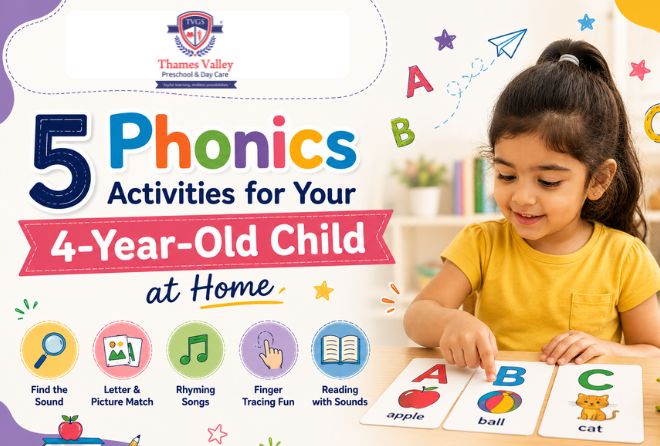
Children begin to learn sounds earlier than we think. The next day, your child has gone from repeating funny words to pointing to letters on packets, books, or signboards and asking something about them. That is the ideal time to begin phonics! Here is the 5 Phonics Activities for 4-Year-Olds Kids.
By using Phonics, your child will be able to match sounds to letters and will begin to read and speak with increasing confidence over time. This blog will explain what phonics is, 5 simple activities you can do at home, and how the right preschool can help your child’s learning journey.
What is Phonics Learning and Why is it Important for Children?
Phonics is teaching children letters that have a sound. For instance, the alphabet letter “A” is pronounced differently in the word “apple” than it is in the word “ball”.
As children begin to recognise sounds, they begin to slowly understand words independently. They don’t memorize things but learn to use phonics for reading and to understand words naturally.
This makes reading easier and enjoyable. It also fosters confidence, vocabulary, listening, and speaking skills. Children who start to learn phonics at an early age are more often to be comfortable when they start formal school learning.
5 Phonics Activities for Preschool Kids
These activities are easy and fun and can be completed in daily family time.
Find The Sound:
Look at objects around the house, such as a cup, ball, or spoon, and find the Sound Pick. Have your child look for an object that begins with the “b” sound or “s” sound. This aids children’s hearing of initial sounds.
Letter and Picture Match:
Draw small pictures like a fish, a cat, or a sun. Then, write out the initial letters of the words on their own and guide your child to connect the corresponding letters. This helps to develop the concept of letter recognition naturally.
Rhyming Songs:
Sing simple nursery rhymes together (rhyming songs). Stop before the rhyming word, and have your child guess the word. Children can listen and understand rhyming games.
Finger Tracing Fun:
Spread flour or sand, and have your child learn the sounds by tracing the letters with their finger. Touch and move, and the kids love learning.
Reading with Sounds:
Repeat simple sounds clearly when reading storybooks. For instance, make the “m” sound in monkey and the “s” sound in sun. Your child will gradually be able to hear these sounds without your help.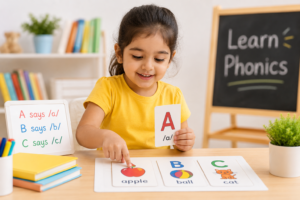
Choosing the best PreSchool for phonics education
The best preschool should be a natural and enjoyable learning environment. This age group of children learns best through stories, games, movement, music, and hands-on experiences. Observe children when they visit and feel comfortable, curious, and engaged in a preschool.
In Thames Valley Preschool & Daycare, the introduction of phonics is gradual and happens when they are not rushed or put under pressure to learn it. The aim is not just reading but confidence, communication, and a love of learning.
Conclusion
Phonics learning at home doesn’t have to be overwhelming. Never underestimate the power of your child’s confidence in sounds, words, and reading; it can be nurtured at any time during the day, and during everyday activities. This 5 Phonics Activities for 4-Year-Olds Kids is help to kids to understand the Phonics at home
Your child will have a more enjoyable learning experience with the right support and direction from home and preschool. For more information on Thames Valley Preschool & Daycare phonics teaching, please contact our team.
FAQs
1. What are phonics activities for preschool children?
Phonics activities help preschool children learn the connection between letters and sounds through games, songs, reading, and fun learning exercises.
2. What is the best age to start phonics learning?
Children can start learning phonics between the ages of 3 and 5 years through simple sound recognition and interactive activities at home or preschool.
3. How do phonics activities improve reading skills?
Phonics activities help children identify letter sounds, recognise words, improve pronunciation, and develop early reading confidence naturally.
4. Can parents teach phonics at home?
Yes, parents can teach phonics at home using storytelling, rhyming songs, letter games, flashcards, and everyday sound activities in a fun way.
5. Why is phonics important for preschool kids?
Phonics builds strong early literacy skills and helps preschool children improve speaking, listening, vocabulary, and reading abilities from an early age.