



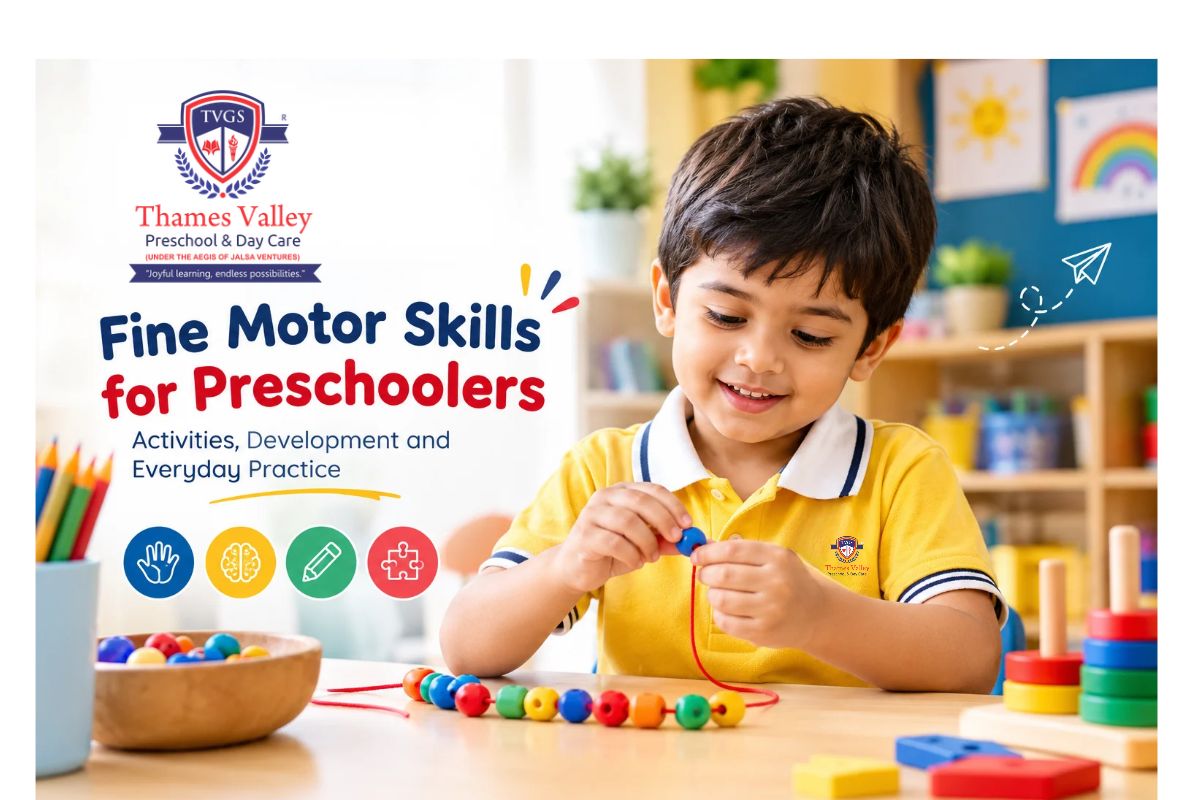
Fine Motor Skills for Preschoolers are skills that develop the delicate muscles of the hands and fingers of children. These can be developed through many activities such as moving, drawing, playing, listening, trying, failing and trying again. This article explains how everyday activities can support fine motor activities and when to discuss with a professional in case of any concerns.
This article is a part of Thames Valley Preschool’s parent learning hub on child development.
Everyday Fine Motor Activities
Threading large beads, playing with dough, tearing and pasting paper, building with small blocks, turning pages, using tongs and closing buttons are activities that strengthen hand control. Drawing and pre-writing should not be the only route to fine motor development.
A child’s environment should give him or her repeated opportunities to practice these skills. Small developments every day is more valuable than a routine that lasts for a week.
From Hand Strength to Pencil Control
Holding a pencil is a required skill before writing can be commenced. Shoulder stability, hand strength, finger isolation, bilateral coordination and visual motor control contributes to the skill. Activities should aim to build these foundations so that later pencil writing is more comfortable.
Parents should enquire whether the environment gives their child repeated, low-pressure opportunities to practice.
Development Is Broad, Connected and Individual
Preschool development is broad and interconnected – movement, hand control, language, thinking, social interaction, emotional regulation and growing independence all influence each other. Building with blocks utilize fine motor skills and spatial reasoning while a group game utilizes movement, language and social skills. At our center, rich, everyday experiences are more important than focusing on a single ability.
Milestones Are Guides, Not a Competition
Developmental milestones are meant to guide parents, but are not a ranking system to compare children. CDC milestone resources include the ages three, four and five and guide parents on how they should observe their child. Instead of comparing their child with other students, parents should discuss concerns with a health professional.
Play Builds Skills in Context
When children pour water, stack blocks, climb, draw, sing, listen to stories, negotiate roles in pretend play and clean materials, they are naturally practicing development skills. UNICEF’s Care for Child Development approach focuses on play and communication activities that support motor, cognitive-language and social-emotional skills. While playing, skills are utilized for a meaningful purpose.
The Adult’s Role Is to Observe and Extend
It is not required of adults to control every activity. Adults can support their children by watching what they are able to do and adding a meaningful challenge – such as a harder puzzle, a longer sentence to repeat, a narrower path to balance along or a question that encourages explanation. This leads to the child becoming an active participant in learning.
Practical Ideas Parents Can Try This Week
Parents can spend ten minutes with their child in a play, read and discuss a picture book every day, include drawing, construction or play dough, create a movement challenge, and note one new skill or phrase.
Repeat a simple experiment, and maintain it before adding a change to it. Consistency leads to a better response from preschool children.
How Thames Valley Preschool Fits Into the Conversation
Thames Valley Preschool provides a child-centred environment that provides attention to a child’s physical, social, emotional and intellectual development, and seeks to achieve these developmental outcomes through age-specific preschool programmes. Families should enquire how a relevant routine or developmental milestone is supported at their local centre, as day to day implementation varies by programme and age-group.
The Key Takeaway
Fine Motor Skills for Preschoolers are a part of a child’s wider development rather than a single achievable target. Parents should have age-appropriate expectations, create repeated opportunities to practice and observe the child’s responses. In case of persistent concern, medical advice should be sought rather than reliance upon online guidance.
Frequently Asked Questions (FAQs)
Q1: Why is fine motor skills for preschoolers important in the preschool years?
Ans: The preschool years is when children develop their habits, communication and movement skills, independence and social-emotional skills. Repeated everyday experiences create useful habits that are the foundation for later wellbeing.
Q2: Should every preschooler develop at exactly the same pace?
Ans: No, as children differ in their temperament, experience and developmental pace. Milestones and age guidance are reference points, not a competition.
Q3: How can parents and preschool work together?
Ans: Parents should share relevant routines and observations with preschools, use consistent language and enquire how the skill is supported during the school day. They should focus on small, practical goals instead of expecting identical behaviour in every setting.
Q4: When should parents seek professional advice?
Ans: Parent should seek professional advice if an issue is persistent, involves safety or health, interferes with daily life, or when a child has lost a skill they previously had.
Q5: What can we do at home to build fine motor skills?
Ans: Let your child play with dough, thread beads, tear paper or stack blocks. Do it for a few minutes every day and keep it fun.
Q6: How do fine motor skills help in school?
Ans: Your child can hold a pencil, draw, button clothes and open the lunchbox alone. This makes them feel confident.
Q7: When does a child start holding a pencil properly?
Ans: Usually between 3 and 5 years. Every child is different, so don’t worry if it takes a little longer. Thick crayons help.
Q8: Is screen time bad for fine motor skills?
Ans: Too much screen time means less play with hands. Keep screen time limited and let your child draw, build and pour.
Q9: What if my child gets upset while doing these tasks?
Ans: Give small and easy tasks. Praise the effort, not just the result. Never compare with other children.
Q10: How does a preschool help with fine motor skills?
Ans: Teachers plan art, puzzles, sensory play and daily life activities. They watch each child’s progress and share updates with parents.
References
WHO — Guidelines on physical activity, sedentary behaviour and sleep for children under 5: https://www.who.int/publications/i/item/9789241550536
CDC — Developmental Milestones: https://www.cdc.gov/act-early/milestones/
NAEYC — Developmentally Appropriate Practice: https://www.naeyc.org/resources/position-statements/dap/principles
NAEYC — The Power of Playful Learning: https://www.naeyc.org/resources/pubs/yc/summer2022/power-playful-learning
UNICEF — Care for Child Development: https://www.unicef.org/documents/care-child-development
NHS — Sleep and young children: https://www.nhs.uk/baby/health/sleep-and-young-children/
NHS — Separation anxiety: https://www.nhs.uk/baby/babys-development/behaviour/separation-anxiety/
Thames Valley Preschool — Official website: https://thamesvalleyglobal.org/
Thames Valley Preschool — Admissions: https://thamesvalleyglobal.org/admission/
Gross Motor Skills for Preschoolers: Development, Activities
October 13, 2026[…] Developmental milestones list the skills that children must have by particular ages. Even though they are informative, they are not a ranking system or seek to promote competition among children. CDC milestones cover the ages of three, four and five and encourages parents to observe their children play, learn, move and act. Parents should seek progress over perfection, and in case of any concerns discuss them with a health professional. […]