



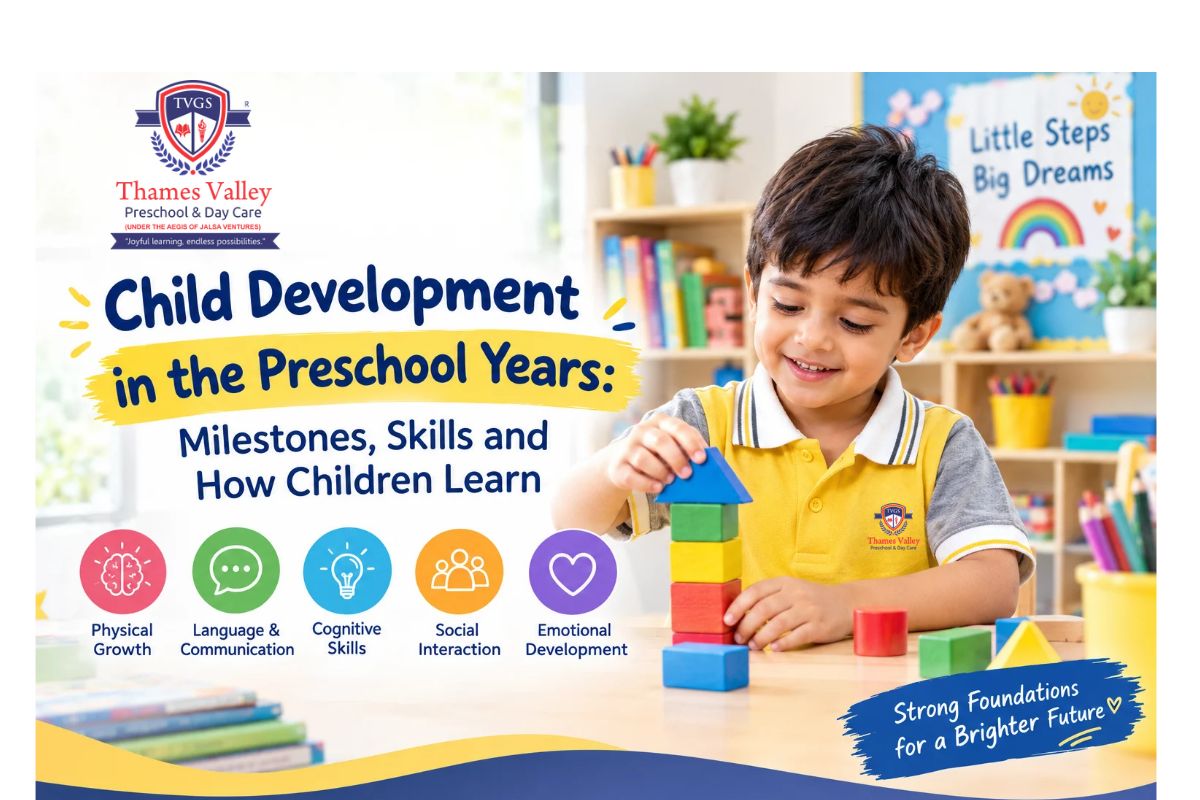
Children develop through many small experiences such as talking, drawing, playing, trying, failing and trying again. Child Development in the Preschool Years: Milestones, Skills and How Children Learn explains what parents can look for, how daily preschool and home activities can support development and when a concern should be discussed with a professional.
This article is part of Thames Valley Preschool’s series on
Development Is Broad, Connected and Individual
Development during preschool years include movement, hand control, language, thinking, social interaction, emotional regulation and independence. Simple activities such as playing with blocks builds fine motor control and reasoning, while a group game builds movement, language, and social skills.
Attending a preschool helps children develop patterns over days and weeks. Parents can also share information with educators to ensure their child’s steady progress in a supportive environment.
Milestones Are Guides, Not a Competition
Developmental milestones need not apply to all children, as there are developmental differences between children. The CDC milestone resources list milestones for the ages three, four and five and encourage parents to observe how a child plays, learns, speaks and moves. Parents should check for progress over time and speak with a health professional if required. Parents should look for patterns over days and weeks, and share relevant information with educators. The goal is to ensure steady progress in a supportive environment.
Play Builds Skills in Context
When children are pouring water, stacking blocks, climbing, drawing, listening, and negotiating roles in pretend play, they are also building developmental skills naturally. UNICEF’s Care for Child Development emphasize play and communication activities that develop the motor, cognitive-language and social emotional skills.
The Adult’s Role
Adults should not seek to control every activity, but rather watch what a child is doing and add a challenge such as a much harder puzzle or a question. This makes sure that a child remains an active participant.
Respond Early to Concerns
Parents are more familiar with a child’s everyday behavior than teachers, who are only able to observe them in a group as they perform activities. Parents should share observations with children as it can reveal useful patterns. If a child is not achieving developmental milestones or a parent has consistent concern, parents should resolve it by discussing it with the child’s doctor. Choosing the right preschool admission can also help parents understand the learning environment and developmental support available at a preschool.
Practical Ideas Parents Can Try This Week
Parents can spend time in a child-led play, read and discuss one picture daily and create a simple movement challenge and learn one new skill or phrase without turning it into a test. The experiment should be simple enough to be able to repeat as children respond better to consistency and modelling instead of repeated reminders.
How Thames Valley Preschool Fits Into the Conversation
Thames Valley Preschool provides a child-centric environment which ensures the child’s physical, social, emotional and intellectual development, and provides age-specific preschool lessons. Parents should discuss how a relevant routine or developmental area is supported at their local center, as implementation depends upon the programme and age group.
The Takeaway
Child Development in Preschoolers should ensure a child’s wider development instead of a single target to achieve. There should be age-appropriate expectations and repeated opportunities to practice, observe the child’s response and work with educators at our center where required. In case of a consistent concern, individual advice should be sought instead of relying upon online guidance.
FAQ (Frequently Asked Question)
Q1: Why is child development in preschoolers important in the preschool years?
Ans: The preschool years are years of rapid growth in habits, communication, movement, independence and social-emotional skills. Creating routines and patterns during this period can create useful foundations for life.
Q2: Should every preschooler develop at exactly the same pace?
Ans: No, as children are different in terms of their temperament, experience and developmental pace. Milestones are reference points, but should not be used to compare between children. In case of any persistent difficulties, parents should contact a professional.
Q3: How can parents and preschool work together?
Ans: Parents and preschools can exchange relevant routine information, and enquire how the skill is supported during the day. They should focus on a small number of practical goals rather than expecting identical behaviour.
Q4: When should parents seek professional advice?
Ans: Parents should seek appropriate advice when a concern is persistent and severe, involves health or safety or interferes with daily life.
Q5: What are the key areas of child development during preschool?
Ans: Key areas include physical growth, communication, cognitive skills, social interaction, emotional development, and independence.
Q6: How can parents support child development at home?
Ans: Parents can encourage learning through storytelling, creative play, daily conversations, and consistent routines.
Q7: What role does preschool play in child development?
Ans: Preschool helps children develop social skills, communication, independence, and problem-solving through guided activities.
Q8: How does play support early childhood development?
Ans: Play encourages creativity, imagination, motor skills, and teamwork while helping children learn naturally.
Q9: How can children develop social and emotional skills?
Ans: Parents can teach children to express feelings, share, take turns, and treat others with kindness.
Q10: How can parents track their child’s developmental progress?
Ans: Parents can observe everyday skills and discuss progress with preschool educators. Seek professional advice if concerns persist.
References
1.WHO — Guidelines on physical activity, sedentary behaviour and sleep for children under 5: https://www.who.int/publications/i/item/9789241550536
2. CDC — Developmental Milestones: https://www.cdc.gov/act-early/milestones/
3. NAEYC — Developmentally Appropriate Practice: https://www.naeyc.org/resources/position-statements/dap/principles
4.NAEYC — The Power of Playful Learning: https://www.naeyc.org/resources/pubs/yc/summer2022/power-playful-learning
5.UNICEF — Care for Child Development: https://www.unicef.org/documents/care-child-development
6.NHS — Sleep and young children: https://www.nhs.uk/baby/health/sleep-and-young-children/
7.NHS—Separation anxiety: https://www.nhs.uk/baby/babys-development/behaviour/separation-anxiety/