


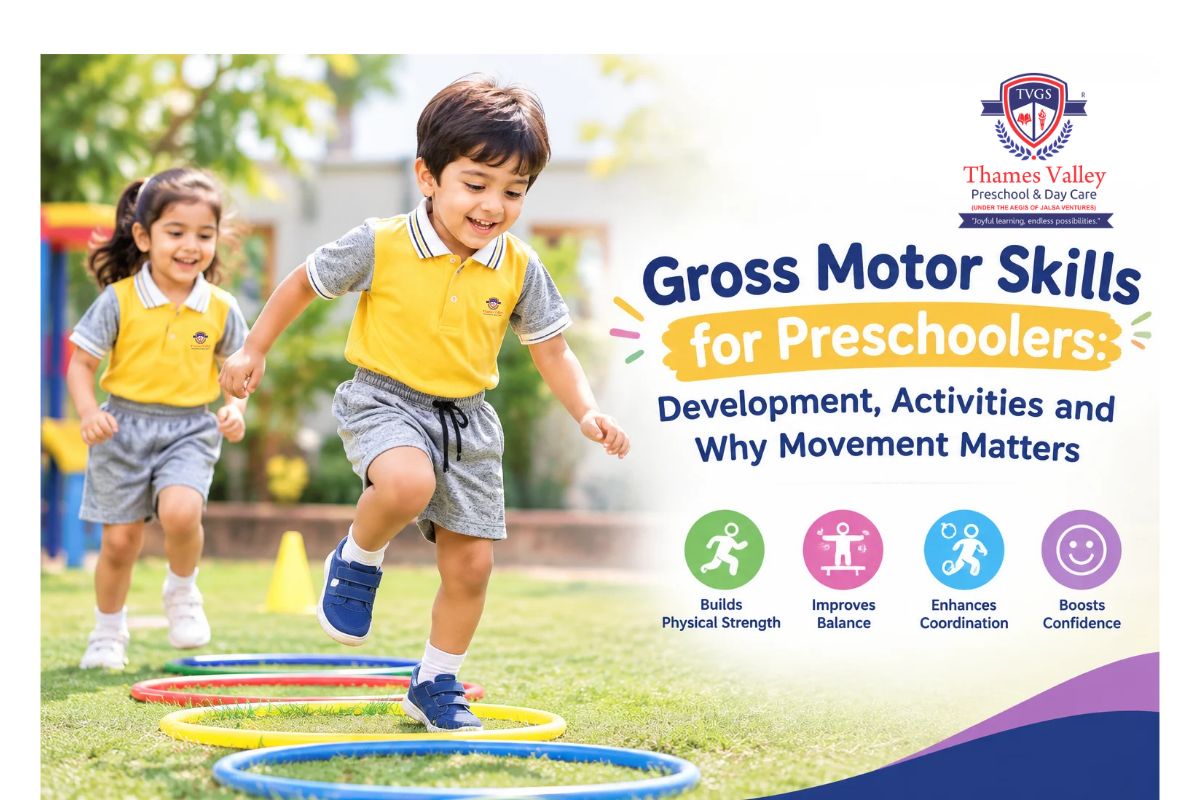
Gross Motor Skills for Preschoolers are encouraged in students through many activities such as talking, moving, drawing, playing, listening, trying, failing and trying again. This article lists how parents can support the development of their child’s gross motor skills, and when concerns should be discussed with professionals.
This article is a part of Thames Valley Preschool’s parent learning hub on child development in the preschool years.
Movement Skills Preschoolers Practise
Preschoolers practice many movement skills such as running, jumping, climbing, balancing, throwing, kicking, and catching, which develop through repeated active play. Many playground fames utilize these abilities while also developing the child’s confidence.
It is important that the environment gives the children repeated, low pressure opportunities to practice these activities that develop their gross motor skills. It is better to make small adjustments every day than follow an ambitious routine for a week.
Give Movement Enough Time
According to WHO, children between the ages of three and four should carry out physical activity for atleast 180 minutes in a day, with 60 minutes of moderate-to-vigourous activity. This can involve outdoor play, walking, dancing and energetic games. A child should not necessarily be able to perform these activities perfectly but should be provided many opportunities to practice.
Development Is Broad, Connected and Individual
Preschool development involves movement, hand control, language, thinking, social interaction, emotional regulation, and growing independence. These areas impact the other areas – building with blocks also utilises fine motor control and spatial reasoning. Playing a group game utilizes movement, language and social skills.
Milestones Are Guides, Not a Competition
Developmental milestones list the skills that children must have by particular ages. Even though they are informative, they are not a ranking system or seek to promote competition among children. CDC milestones cover the ages of three, four and five and encourages parents to observe their children play, learn, move and act. Parents should seek progress over perfection, and in case of any concerns discuss them with a health professional.
Play Builds Skills in Context
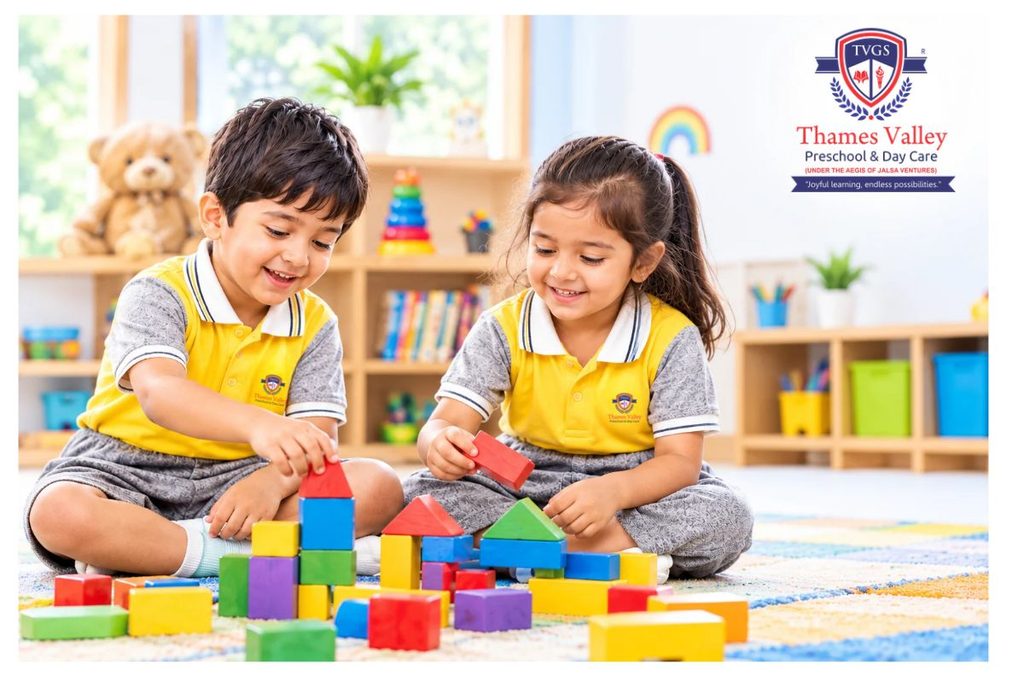
Children build developmental skills when they perform simple activities such as pouring water, stacking blocks, climbing, drawing, singing and listening to stories. UNICEF’s Care for Child Development approach also upholds the importance of play and communication activities to develop motor, cognitive-language and social-emotional skills. Skills are developed through play when activities are repeated.
The Adult’s Role Is to Observe and Extend
Instead of trying to control their child’s activity, the adult’s role is to support and watch their child’s actions. They can add simple challenges to their child’s games such as presenting a slightly harder puzzle, a longer sentence to repeat, a narrower path to balance, or asking a question that encourages explanation. This makes the child an active participant while ensuring the learning gains.
You may also like How to Make Your Child’s First Day at Preschool Stress-Free
Practical Ideas for Parents to Try
Parents can spend a few minutes in their child’s play. They can read and discuss one picture book every day, include drawing, construction and playing with dough. They can also create a simple movement challenge without turning it into a test.
Parents should keep the experiment simple enough, and maintain it before adding changes. It is better to teach students through consistency and modelling than through a long list of expectations.
How Thames Valley Preschool Fits Into the Conversation
Thames Valley Preschool provides a nurturing and child-centric environment which pays attention to the child’s physical, social, emotional and intellectual development. Families should enquire how their child’s development is supported at their local preschool center, as program implementation can differ by age group and location.
The Key Takeaway
Developing Gross Motor Skills for Preschoolers is not a single target to optimize but a part of the child’s wider journey. Expectations should be kept age-appropriate, with repeated opportunities to practice. In case of a persistent concern, individual medical advice should be sought rather than relying on online guidance.
FAQ
Q1: Why is gross motor skills for preschoolers important in the preschool years?
Ans: Preschool years are very important in terms of growing habits, communication skills, independence and social-emotional skills. Everyday experiences during this period can create useful foundations for wellbeing.
Q2: Should every preschooler develop at exactly the same pace?
Ans: No, as children differ in temperament and development pace. Milestones and age guidance are reference points, and not a competition. Any developmental concerns should be discussed with an appropriate professional.
Q3: How can parents and preschool work together?
Ans: Parents should discuss observations about their child with the preschool, and ask about how the preschool is developing skills among their students. Parents and preschools should work collectively to ensure skill development, and parents should share routines and use consistent language when discussing their child’s developmental journey.
Q4: When should parents seek professional advice?
Ans: Parents should seek individual advice when there is a severe or persistent issue that involves harm to health and safety, or when a child has lost a skill that they previously had.
Q5: What are gross motor skills in preschoolers?
Ans: Gross motor skills involve large muscle movements, such as running, jumping, climbing and balancing.
Q6: How can preschoolers improve gross motor skills?
Ans: Children can practise through outdoor play, dancing, jumping and age-appropriate physical activities.
Q7: Why is outdoor play important for gross motor development?
Ans: Outdoor play helps children practise movement, balance, coordination and body control.
Q8: Which activities support gross motor skills development?
Ans: Activities like ball games, hopping, running and obstacle courses support physical development.
Q9: How can parents encourage gross motor skills at home?
Ans: Parents can encourage active play, provide safe play spaces and participate in simple movement games.
Q10: Does screen time affect gross motor skills development?
Ans: Excessive screen time may reduce opportunities for active play, so children should have regular time for physical activities.
References
WHO — Guidelines on physical activity, sedentary behaviour and sleep for children under 5: https://www.who.int/publications/i/item/9789241550536
CDC — Developmental Milestones: https://www.cdc.gov/act-early/milestones/
NAEYC — Developmentally Appropriate Practice: https://www.naeyc.org/resources/position-statements/dap/principles
NAEYC — The Power of Playful Learning: https://www.naeyc.org/resources/pubs/yc/summer2022/power-playful-learning
UNICEF — Care for Child Development: https://www.unicef.org/documents/care-child-development
NHS — Sleep and young children: https://www.nhs.uk/baby/health/sleep-and-young-children/
NHS — Separation anxiety: https://www.nhs.uk/baby/babys-development/behaviour/separation-anxiety/