




Four is an important age for children. At this stage, a child moves beyond basic grip towards genuine precision — cutting along lines, drawing recognisable pictures, and even writing a few letters. It is the perfect age to introduce 15 Home-based Fine Motor Activities for 4-Year-Olds through fun and play-based learning. These activities can help children strengthen hand muscles, improve hand-eye coordination, develop concentration, and become more confident with everyday tasks.
Here are fifteen activities for your child to try at this age to improve their fine motor skills in an enjoyable and engaging way.
What to Expect at Age 4
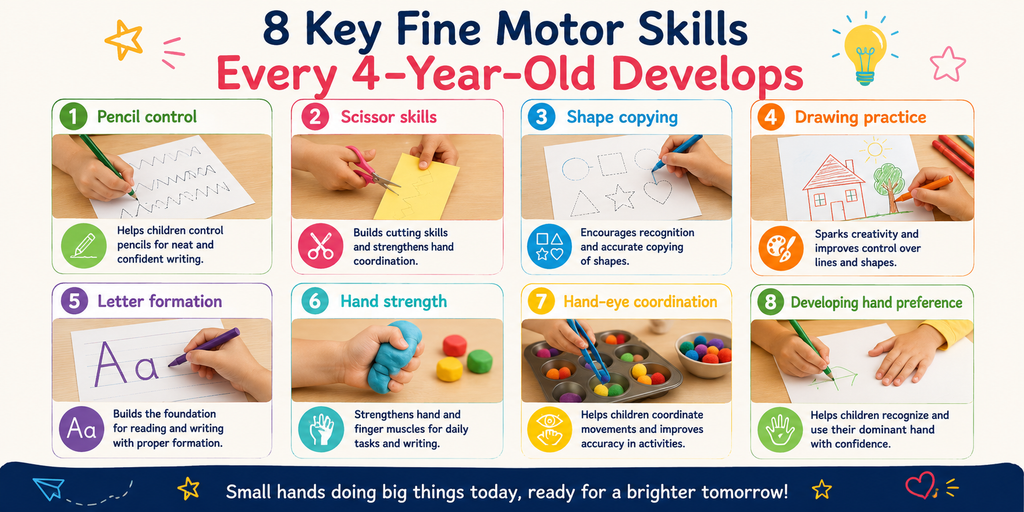
By four, most children can copy shapes such as squares and crosses, draw the figure of a person, cut along a line with scissors, and write some letters. A clear hand preference (left or right) usually begins to emerges by this age, and pre-writing skills really begin to form — so many of the activities mentioned train the hand for using a pencil.
- Pencil control: Encourage drawing, tracing, colouring within lines, and simple pre-writing patterns.
- Scissor skills: Let children practise cutting straight, curved, and simple zigzag lines using child-safe scissors.
- Shape copying: Ask children to copy squares, crosses, circles, and other simple shapes.
- Drawing practice: Encourage them to draw people, houses, animals, or objects using their imagination.
- Letter formation: Introduce simple letters and allow children to practise copying them without pressure.
- Hand strength: Activities such as playdough, squeezing sponges, threading beads, and using tweezers can strengthen small hand muscles.
- Hand-eye coordination: Puzzles, peg boards, buttoning activities, and sorting games help children coordinate what they see with how they move their hands.
- Developing hand preference: Give children opportunities to naturally use whichever hand feels more comfortable rather than forcing a particular hand.
These simple activities can make everyday fine motor practice enjoyable while gradually preparing children for writing, drawing, cutting, dressing, and other self-care skills.
The 15 Activities for Developing Motor Skills
Cutting and Precision
1. Scissor skills. Four is an important age to start working with safe scissors. Children can start with snipping strips and cutting simple curves and shapes. Cutting enhances mental agility and coordination.
2. Cutting playdough. Cutting playdough into shapes with a plastic knifes after rolling them improves fine motor strength and cognitive ability.
3. Hole punching. Children utilising a punch mark to punch holes through a paper can greatly improve their hand strength. They can then move pieces of wool or strings through it.
Drawing and Pre-Writing
4. Shape copying. Drawing a shape such as a circle or square and asking the child to copy them builds their visual-motor control and helps them with writing.
5. Dot-to-dots. Simple connect-the-dots puzzles help build pencil control and hand-eye coordination in a playful and game-based way.
6. Tracing trays. Finger-tracing lines, shapes and letters in a tray of salt, sand or rice helps with the child’s fine motor skills.
7. Mazes. Simple paper mazes help with pencil control — keeping the line inside the path involves precision and motor control.
Threading, Building, and Sorting
8. Bead threading. Improve bead threading skills from the age of three by threading beads with thinner string. To level up, patterns can also be made.
9. LEGO and small blocks. Building LEGO blocks helps with coordinating fingers and building stronger hands.
10. Button and bead sorting. Sorting mixed buttons into an ice-cube tray by colour and size builds precision and early mathematical thinking.
11. Pipe cleaner threading. Threading beads onto pipe cleaners is easier than string and helps build fine motor control.
Strength and Coordination
12. Peg boards. Pushing pegs into a board, or clothes pegs onto the edge of a container, is fantastic pincer and strength practice.
13. Spray bottle games. Spraying water at targets builds good hand strength through the trigger action.
14. Tweezers and small objects. Let your child move from tongs to tweezers and pick up beads or sequins. It is a great precision practice but requires supervise with small parts.
15. Getting dressed. Practising buttons, zips, and even shoelaces is real-life fine motor training, while buttoning a coat is genuine skill-building.
READ MORE – Common Mistakes Parents Make While Choosing a Preschool
Tips for Success With 4-Year-Old Children
Children can handle more challenging activities, but the principles still hold:
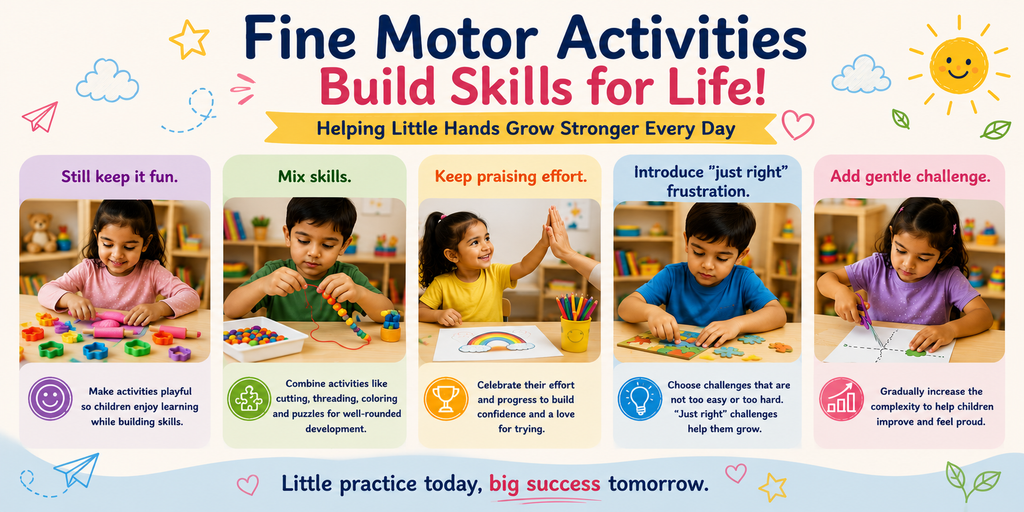
- Add gentle challenge. Make an easy activity a little harder – incorporate smaller beads, curved cutting lines, more detailed drawing.
- Introduce “just right” frustration. A task that takes real effort (but is still achievable) builds skill and patience. Don’t rush to intervene.
- Keep praising effort. Positive encouragement leads to a child who keeps trying harder.
- Mix skills. Combine activities involving cutting, drawing, threading, and strength so that their whole hand develops.
- Still keep it fun. Let the activities continue to be interesting and playful for the child.
About Pencil Grip
At the age of four, your child’s pencil grip naturally develops towards a three-finger “tripod” grasp. You can encourage this gently, but there is no need to force it, as hand strength and coordination develop gradually through regular play. 15 Home-based Fine Motor Activities for 4-Year-Olds such as tracing, cutting, playdough, threading, drawing, and simple mazes can support pencil control, finger strength, and pre-writing skills. For younger children, you can also explore 10 Easy Home-based Fine Motor Activities for 3-Year-Olds.which includes age-appropriate activities that build the foundation for later writing and fine motor development.
The Key Takeaway
At four, 15 Fine Motor Activities for 4-Year-Olds can become more complex — cutting along lines, copying shapes, threading smaller beads, and practising buttons and zips. These skills are quietly preparing your child for writing and greater independence. Preschools and childcare centers can also encourage these abilities through playful, hands-on activities as part of their daily learning routines. If you are planning your child’s admission to a preschool, look for centers that provide age-appropriate fine motor activities alongside creative and play-based learning. Let these activities remain fun and engaging so children can naturally build their skills and confidence.
FAQ’s- ( Frequently Asked Question )
Q1: Which fine motor skills should a 4-year-old have?
Ans: Most 4-year-olds can copy simple shapes such as squares and crosses, draw a basic person, cut along a line, hold drawing tools with better control, and begin writing some letters. Development varies from child to child.
Q2: What are the best home-based fine motor activities for 4-year-olds?
Ans: Drawing, colouring, cutting with child-safe scissors, playdough, threading beads, puzzles, tracing, using tweezers, building blocks, and simple sorting games are excellent options.
Q3: How can fine motor activities help my 4-year-old?
Ans: These activities strengthen the small muscles in the hands and fingers while improving hand-eye coordination, concentration, pencil control, and independence in everyday tasks.
Q4: How can I prepare my 4-year-old’s hands for writing?
Ans: Activities such as tracing, drawing patterns, cutting, threading, playing with dough, and making shapes in sand can build the hand strength and control needed for early writing.
Q5: Should my 4-year-old already use a tripod pencil grip?
Ans: A three-finger or tripod grip may begin to develop around this age, but it does not need to look perfect. Encourage comfortable pencil control through play rather than forcing a specific grip.
Q6: Can cutting with scissors improve fine motor skills?
Ans: Yes. Cutting helps children develop finger strength, hand coordination, visual tracking, and controlled movements. Start with straight lines before introducing curves and simple shapes.
Q7: Are playdough activities good for 4-year-olds?
Ans: Absolutely. Rolling, squeezing, pinching, flattening, and shaping playdough can strengthen the fingers and hands while also encouraging creativity and coordination.
Q8: How often should I practise fine motor activities with my child?
Ans: Short, enjoyable sessions are usually better than long practice periods. Try including a few activities in your child’s daily play routine and allow them to stop when they lose interest.
Q9: What activities can improve pencil control in a 4-year-old?
Ans: Colouring, tracing, simple mazes, drawing shapes, connecting dots, drawing patterns, and using stickers are useful ways to practise controlled hand movements before focusing heavily on handwriting.
Q10: What if my 4-year-old is struggling with fine motor activities?
Ans: Give them plenty of opportunities to practise without pressure and choose activities that match their current ability. If you have ongoing concerns about your child’s development or daily functioning, discuss them with a paediatrician or qualified child-development professional.
12 Fine Motor Activities for 5-Year-Olds Before School
August 27, 2026[…] Children’s hands need to be strong and ready before expecting advanced writing skills. Keep fine motor activities playful and focus on readiness rather than forcing children to write too early. When choosing a […]