



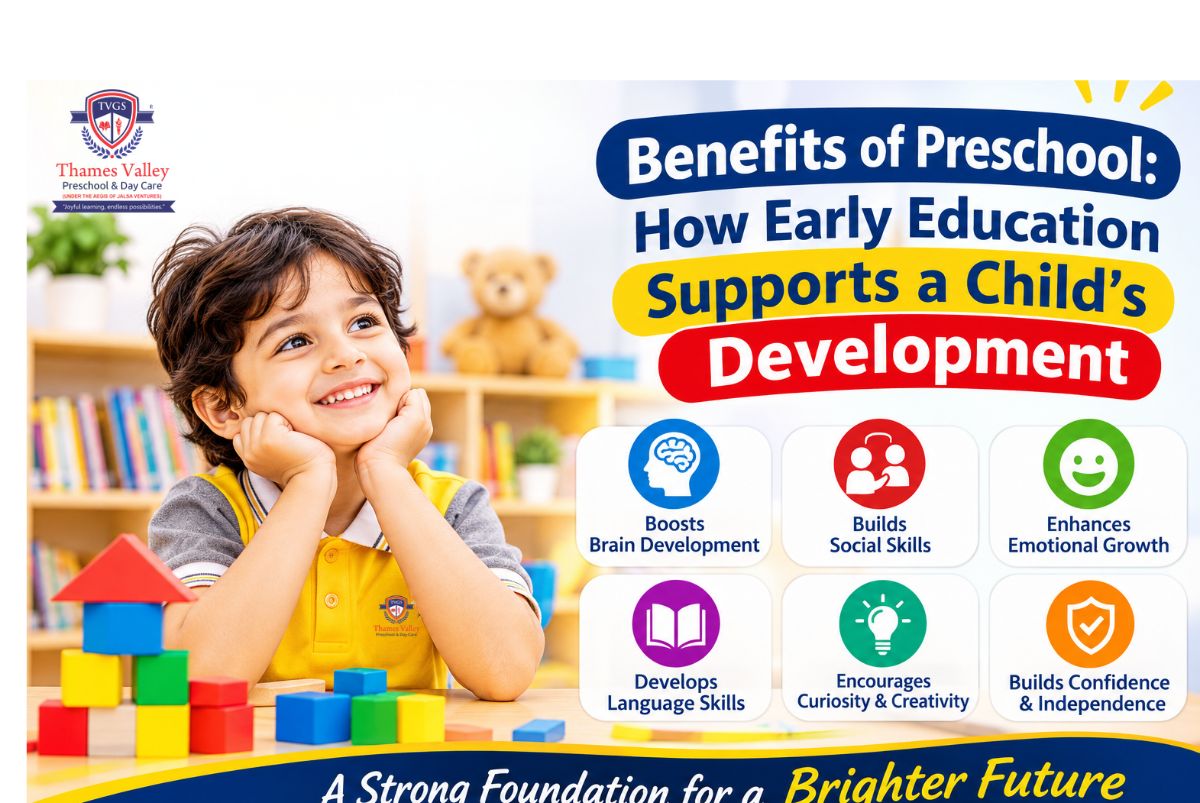
Early education is known to have many beneficial impacts upon a child’s development. Benefits of Preschool: How Early Education Supports a Child’s Development seeks to shed light upon the benefits of preschool for young children, how play and teaching support each other, and what parents should look for in a preschool experience.
Learning to Be Part of a Group
As children attend preschool, they are influenced to be a part of groups of children as they learn to wait, share space, communicate needs, join activities, and solve small social problems with the support of their supervisors. These aspects define their community involvement. Parents should inquire whether the environment gives their child many opportunities to practice their social and communication skills through activities involving group work.
A Language- and Experience-Rich Environment
Attending a preschool provides students with many opportunities to practice storytelling, sing songs, engage in conversations, create art, construct blocks and other materials, and be a part of exploratory activities that broaden a child’s horizon of knowledge. Children should be encouraged to revisit ideas learned through the preschools, as early learning is often the result of repetition.
Preschool Is More Than Early Academics
Preschool offers many opportunities for meaningful development. It serves as a developmental bedrock for developing many essential skills in students through activities such as language-rich interaction, movement, play, stories, and exploration. They are given many life lessons beyond basic literacy and numeracy.
Why Play and Learning Belong Together
Early education is often delivered through play, as play utilizes preschoolers’ complex thinking skills. Building a simple block tower involves using skill sin planning and cause-and-effects, while pretend play draws upon language and communication skills. According to NAEYC, play and learning are often complementary for very young children, and many early curricula often draw upon play to deliver meaningful learning lessons to students.
Readiness Is Broader Than Reading and Writing
A child of preschool age should be able to communicate his basic needs, be able to bear separation from his family as he attends preschool, follow simple routines, and be able to participate in play. These skills are refined in preschool and do not need to be perfect before admission. A good preschool should be able to help children develop their skills and ensure that preschool readiness is developed even as the child attends preschool and is not only an entrance requirement.
This article is a part of Thames Valley Preschool’s parent learning hub on the benefits of preschool education
What a Balanced Curriculum Looks Like
A balanced preschool curriculum is judged by its ability to give children opportunities to participate in communication and language, early literacy, early mathematics, physical development, creative expression and social-emotional learning. While ensuring these developments, each child’s individuality and context should be recognized.
Practical Ideas Parents Can Try This Week
Parents can practice some simple activities with their child to develop his skills, such as reading together, encouraging them to pretend-play, and letting the child solve small real-life problems. Parents should inquire about how current classroom activities encourage and achieve learning goals.
Experiments should be simple and repeatable. It should be continued before another change is added, as preschool children require consistency to learn skills.
How Thames Valley Preschool Fits Into the Conversation
Thames Valley Preschool offers a learning model which is a blend of Montessori, STEM, experiental learning and technology-enabled education. Its programs also provide language, numeracy, motor development, practical life activities, and hands-on learning. Through a play-based, experiential learning methodology, Thames Valley Preschool seeks to provide a holistic learning experience to its students.
The Key Takeaway
Preschools aim to develop a child holistically, instead of achieving “targets” of learning. Parents should work with educators and observe the child’s response to learning. Any concerns in learning should be discussed with the teachers, while medical issues should be discussed with the healthcare provider.
Frequently Asked Questions (FAQs)
Q1: Why is benefits of preschool important in the preschool years?
Ans: The preschool years are important, as they propel growth in habits, communication, movement, independence, and social-emotional skills. When preschoolers repeat experiences during this period, they create useful foundations for later learning and well-being.
Q2: Should every preschooler develop at exactly the same pace?
Ans: Children are different in terms of their developmental pace and temperament. Milestones and age guidance provide useful guidance but are not meant to compare between students.
Q3: How can parents and preschool work together?
Ans: Parents and preschools should share routines and observations. Parents should inquire how a skill is supported during a school day and lay emphasis on achieving practical goals.
Q4: When should parents seek professional advice?
Ans: If a concern is persistent or severe and interferes with daily life, parents should seek professional advice.
Q5: Why is play-based learning important in preschool?
Ans: Play helps children ask questions, solve problems, and cooperate with others. When learning feels enjoyable, children build confidence and understand new concepts more easily.
Q6: How can parents tell if a child is ready for preschool?
Ans: Look for signs such as expressing basic needs, following a short routine, and showing interest in other children. Perfect readiness is not required, as preschool supports these skills gradually.
Q7: How do preschoolers develop social-emotional skills?
Ans: Group activities and teacher guidance help children recognise and manage their feelings. Everyday experiences like sharing and taking turns strengthen these skills over time.
Q8: What habits can parents support at home?
Ans: Reading stories, talking regularly, and keeping consistent sleep and meal routines are simple, effective steps. Letting children do small tasks themselves also builds independence.
Q9: How much screen time is appropriate for preschoolers?
Ans: Screen time should be limited and purposeful, such as watching educational content together with a parent. Excess screen use can reduce physical activity, sleep, and face-to-face interaction.
Q10: What should parents look for when choosing a preschool?
Ans: Look for a safe and clean environment, trained teachers, a balanced daily routine, and open communication with parents. A school visit helps you see whether children seem comfortable and engaged.
References
WHO — Guidelines on physical activity, sedentary behaviour and sleep for children under 5: https://www.who.int/publications/i/item/9789241550536
CDC — Developmental Milestones: https://www.cdc.gov/act-early/milestones/
NAEYC — Developmentally Appropriate Practice: https://www.naeyc.org/resources/position-statements/dap/principles
NAEYC — The Power of Playful Learning: https://www.naeyc.org/resources/pubs/yc/summer2022/power-playful-learning
UNICEF — Care for Child Development: https://www.unicef.org/documents/care-child-development
NHS — Sleep and young children: https://www.nhs.uk/baby/health/sleep-and-young-children/
NHS—Separation anxiety: https://www.nhs.uk/baby/babys-development/behaviour/separation-anxiety/