



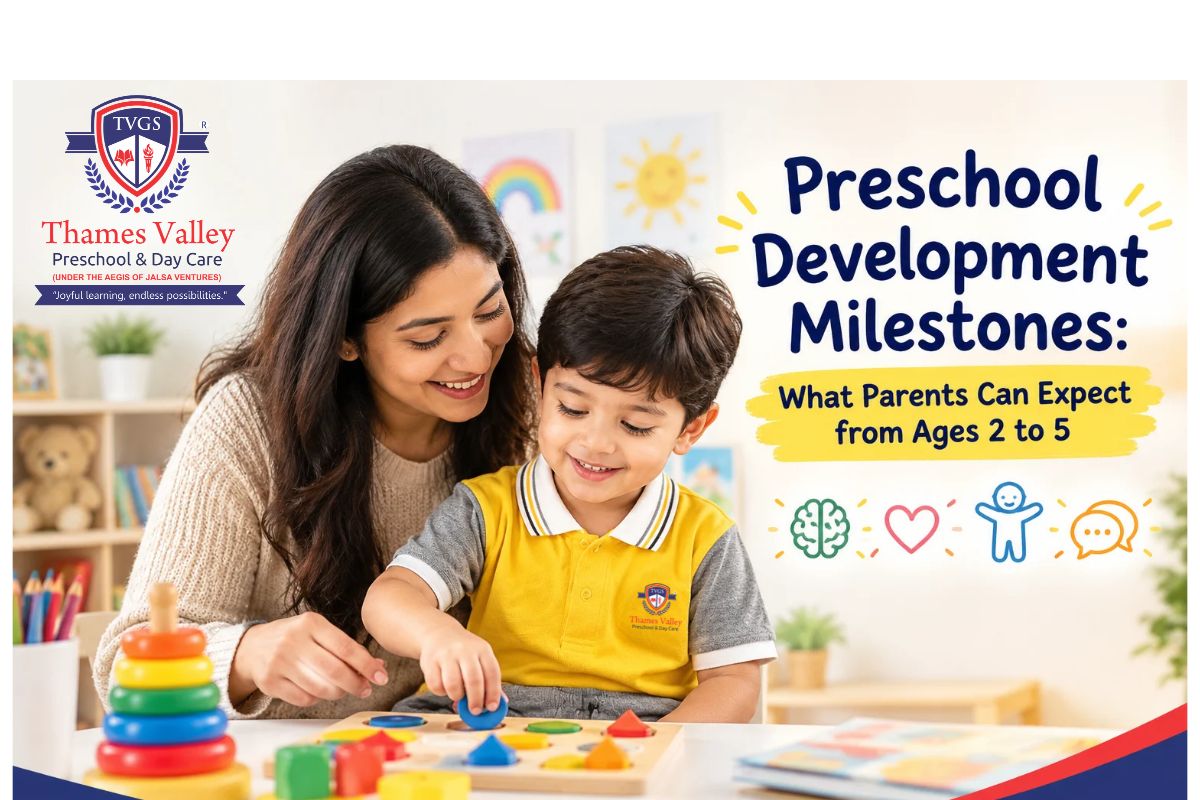
There are several small experiences such as talking, moving, drawing, playing and listening that influence preschool developmental milestones. This article explains what parents should observe, how everyday activities support development and when a concern should be discussed with a professional.
Development Is Broad, Connected and Individual
Preschool years are the age when children are developing on many fronts. Their development encompasses movement, hand control, language, thinking, social interaction, emotional regulation and independence. These growth areas are intertwined: building with blocks uses fine motor control and spatial reasoning, while a group game utilizes movement, language and social skills at the same time. This is why preschool years games and playing experiences hold value for the child.
Milestones Are Guides, Not a Competition
Developmental milestones exist to guide the parents on the skills a child must have learned by a particular age. These guidelines are meant to be informative and not a rigid ranking system. CDC milestones cover the ages of three, four and five and guide parents to observe how a child plays, learns, speaks and moves. Parents should seek their child’s progress over time and discuss any concerns with a health practitioner. Parents should refrain from directly comparing their child with other children.
Play Builds Skills in Context
Through activities such as pouring water, stacking blocks, climbing, drawing, singing, listening to stories, negotiating roles in pretend play and tidying materials, children naturally build various skills. UNICEF’s Care for Child Development approach likewise emphasizes play and communication activities that support motor, cognitive-language and social-emotional skills. Through play and repetition, skills are built in a meaningful way.
The Adult Should Observe and Extend
Instead of seeking to control every activity, adults should watch what the child is capable of doing, and add a manageable challenge to it—such as a slightly harder puzzle or a longer sentence to repeat. This allows the child to learn more while being an active participant.
This article is a part of Thames Valley Preschool’s parent learning hub on child development.
Practical Ideas Parents Can Try This Week
Parents can spend some time in their child’s play, discuss a picture book every day, participate in their child’s drawing and play dough activities, create a simple movement challenge, and note one new skill or phrase without turning it into a test. The experiment should be simple enough to be repeatable.
How Thames Valley Preschool Fits Into the Conversation
Thames Valley Preschool provides a child-centric environment to the child with attention to his or her physical, social, emotional and intellectual development along with age-specific preschool programs. Families should discuss how a relevant routine or developmental activity can be supported at the local preschool center, as day-to-day implementation varies by programme and age group.
The Key Takeaway
Preschool developmental milestones should not be thought of as rigid by the parents and educators, as it seeks to merely provide an indication of the child’s growth. At our center, Expectations should be age-appropriate and the child’s responses should be observed. In case of persistent or medical concerns, individual professional advice should be sought instead of depending upon online advice.
Frequently Asked Questions (FAQs)
Q1: Why is preschool development milestones important in the preschool years?
Ans: Preschool years define an age with rapid development in habits, communications, movement, independence and social-emotional skills. Repeating habits and experiences during these years can create foundations for life.
Q2: Should every preschooler develop at exactly the same pace?
Ans: No, as children are different in terms of their temperament, experience and developmental pace. Milestones are useful but not definitive. Concerns or the loss of previously acquired skilled should be discussed with a healthcare professional.
Q3: How can parents and preschool work together?
Ans: Parents should share their child’s routines with the preschool, along with any observations, and enquire how the skill is supported during the day. They should seek to focus on practical goals instead of identical behaviour in every setting.
Q4: When should parents seek professional advice?
Ans: Parents should seek individual advice when a concern is persistent, severe, involves health or safety, interferes with daily life and when a child has lost a previously acquired skill.
Q5: What are the key preschool development milestones between ages 2 and 5?
Ans: Key milestones include improving language and communication, developing motor skills, learning basic problem-solving, building social relationships, and becoming more independent in everyday activities.
Q6: How can parents support preschool development at home?
Ans: Parents can support development through storytelling, drawing, puzzles, outdoor play, simple household tasks, and regular conversations. These activities help children learn naturally through everyday experiences.
Q7: What role does preschool play in a child’s development?
Ans: Preschool provides opportunities for children to learn through play, interact with other children, follow routines, develop communication skills, and build confidence in a structured environment.
Q8: How do play-based activities help children reach developmental milestones?
Ans: Play-based activities encourage creativity, coordination, language development, problem-solving, and social interaction. Activities such as building blocks, role-playing, and group games support different areas of development.
Q9: Can a child’s environment affect preschool development milestones?
Ans: Yes, a child’s environment can influence learning and development. Supportive relationships, consistent routines, nutritious food, sufficient sleep, and opportunities to explore can help children develop important skills.
Q10: How can parents track their child’s preschool development milestones?
Ans: Parents can observe their child’s progress in communication, movement, social interaction, and independence. Sharing observations with preschool teachers and discussing persistent concerns with a healthcare professional can help identify where additional support may be needed.
References
Editorial note: verify health and developmental claims against authoritative guidance before publication. Sources accessed September 2026.
WHO — Guidelines on physical activity, sedentary behaviour and sleep for children under 5: https://www.who.int/publications/i/item/9789241550536
CDC — Developmental Milestones: https://www.cdc.gov/act-early/milestones/
NAEYC — Developmentally Appropriate Practice: https://www.naeyc.org/resources/position-statements/dap/principles
NAEYC — The Power of Playful Learning: https://www.naeyc.org/resources/pubs/yc/summer2022/power-playful-learning
UNICEF — Care for Child Development: https://www.unicef.org/documents/care-child-development
NHS — Sleep and young children: https://www.nhs.uk/baby/health/sleep-and-young-children/
NHS — Separation anxiety: https://www.nhs.uk/baby/babys-development/behaviour/separation-anxiety/