



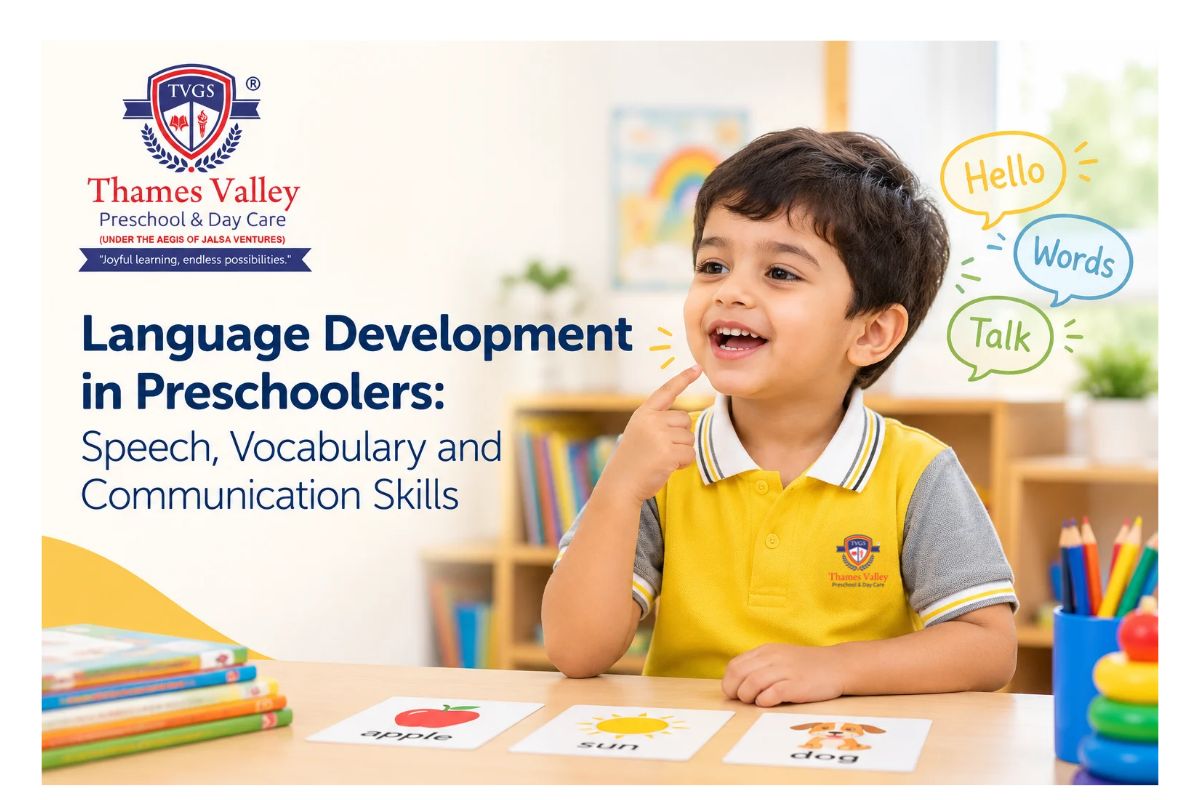
Language Development in Preschoolers happens through experiences such as talking, moving, drawing, playing and listening. This blog explains how language develops in preschool-aged children, and what parents can do to promote effective language development of their child.
Conversation Is a Daily Language Lesson
As language develops through interaction, parents can ask children questions and give them the time to respond. Parents can also add more words to their child’s vocabulary by providing more information to the child’s observations. If a child says “good car”, the adult might reply, “Yes, the car looks good and three persons are sitting inside it”. The child will gradually learn to add more words to his or her observations and develop her communication skills.
Stories, Songs and Pretend Play
Stories, songs and play are ways of developing rich vocabulary for children. When children read, they encounter vocabulary and sentence structures that they are not normally familiar with in everyday conversations. Songs build memory, while plays build communication skills as children learn to explain ideas and utilize new words. These experiences develop their verbal abilities.
Development Is Broad, Connected and Individual
Preschool children develop their movement, hand control, language, thinking, social interaction, emotional regulation and independence. No skill is developed in isolation – playing with blocks develops their fine motor skills and spatial reasoning, while a group game develops movement, language and social skills all together.
Milestones Are Guides, Not a Competition
Development milestones, which list a child’s achievements by age, are meant to serve as guides and not a ranking system. CDC milestones cover students between the ages of three to five, and guide parents as they observe their child’sdevelopment. Any concerns should be discussed with a healthcare professional.
Play Builds Skills in Context
While children play and pour water, stack blocks, draw, listen to stories and negotiate roles, they are naturally building developmental skills. UNICEF’s Care for Child Development also encourages play and communication activities, as they build their motor, cognitive-language and social-emotional skills.
The Adult’s Role Is to Observe and Extend
The best way an adult can support a child during this phase of development is first to step back and observe the child’s play and then extend the play by offering a challenge to the child, which could be anything from a slightly harder puzzle to a longer sentence to repeat.
Practical Ideas Parents Can Try This Week
Parents can carry out simple activities such as reading and discussing one picture book every day, drawing or playing with dough with the child or creating a simple movement challenge. These examples should be repeatable and simple.
How Thames Valley Preschool Fits Into the Conversation
Thames Valley Preschool provides a child-centric environment and provides adequate attention to the child’s physical, social, emotional and intellectual development.
The Key Takeaway
Language development in preschoolers should not be a single target to achieve but a part of the child’s wider development. Expectations should be age-appropriate and many opportunities to practice should be provided.
This article is a part of Thames Valley Preschool’s parent learning hub on child development.
Frequently Asked Questions (FAQs)
Q1: Why is language development in preschoolers important in the preschool years?
Ans: Language development in preschool years is important and a part of growth in habits, communication, movement, independence and emotional skills. Everyday experiences during this period should be repeated to create useful foundations for later wellbeing.
Q2: Should every preschooler develop at exactly the same pace?
Ans: No, as children are different in terms of their temperament and developmental pace. Milestones and age guidance are not meant to rank students.
Q3: How can parents and preschool work together?
Ans: Parents and preschools should share the child’s routines and observations among themselves and jointly seek to develop their children’s abilities.
Q4: When should parents seek professional advice?
Ans: Professional advice should be sought when a concern is persistent, and involves concerns related to safety and security of the child.
Q5: What can parents do at home to build language skills?
Ans: Talk with your child during daily routines, name things, ask simple questions and read a picture book every day.
Q6: How does reading stories help language development?
Ans: Stories add new words and longer sentences. Ask your child what happens next to get them talking.
Q7: How many words should a preschooler know?
Ans: There is no fixed number. Every child learns at their own pace, so don’t compare with others.
Q8: What if my child speaks late or is unclear?
Ans: Keep talking and listening with patience. If the delay lasts long, or your child stops using words they knew, see a doctor or speech therapist.
Q9: Does learning more than one language confuse a preschooler?
Ans: No. Children can learn more than one language, and mixing words is normal at this age.
Q10: How does a preschool support language development?
Ans: Through stories, songs, rhymes and group play. Teachers also keep parents updated.
References
Editorial note: verify health and developmental claims against authoritative guidance before publication. Sources accessed September 2026.
WHO — Guidelines on physical activity, sedentary behaviour and sleep for children under 5: https://www.who.int/publications/i/item/9789241550536
CDC — Developmental Milestones: https://www.cdc.gov/act-early/milestones/
NAEYC — Developmentally Appropriate Practice: https://www.naeyc.org/resources/position-statements/dap/principles
NAEYC — The Power of Playful Learning: https://www.naeyc.org/resources/pubs/yc/summer2022/power-playful-learning
UNICEF — Care for Child Development: https://www.unicef.org/documents/care-child-development
NHS — Sleep and young children: https://www.nhs.uk/baby/health/sleep-and-young-children/
NHS — Separation anxiety: https://www.nhs.uk/baby/babys-development/behaviour/separation-anxiety/