


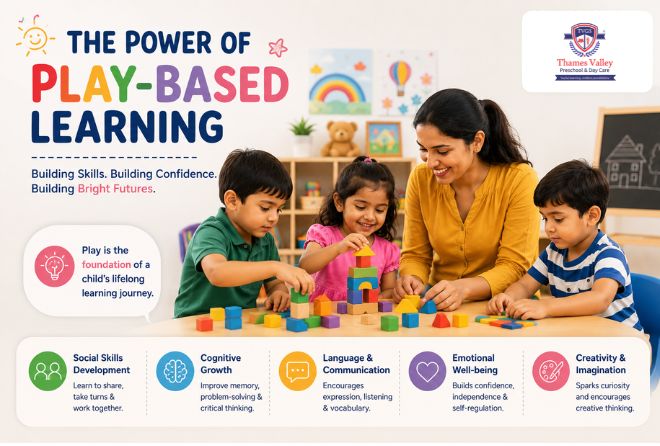
Playing with blocks could be a simple activity for a child to build a tower. Your child learns to wait, balance, focus, and think during this time.
That’s what Power of Play-Based Learning is all about. Children learn through curiosity, movement, conversation, and exploration, helping them to learn naturally. Let this blog help you understand how play supports your child’s learning, confidence, and emotional development during their most formative years.
What is Play-Based Learning?
Play-Based Learning encourages children to learn in an exciting, engaging way. They are placed in a classroom and can be seen building with blocks, playing shop, painting, working on puzzles, or exploring items with others.
Teachers can well manage such experiences. Play is not a random activity that children engage in. Each activity is an aid to growth, curiosity, and understanding, little but significant.
Think about a way to teach adults. It is easier to remember if it is something that you have experienced personally rather than reading about it. Learning Through Play is the same way that young children learn.
This supports good learning foundations and practices in Early Childhood Education.
Benefits of Play-Based Learning for Child Development
Children learn best when involved, active, and interested. There are many ways in which play-based learning can support children’s development.
Simple play-based learning activities, such as sorting shapes, tower building, or ‘cooking’ games, help children build memory, concentration, language, and early maths skills. Learning numbers is natural and pleasant for a child while playing with toy fruits.
These small moments help children develop a lifelong love for learning.
How Play Activities Improve Social and Cognitive Skills
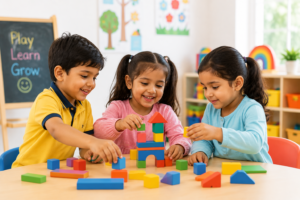
Children learn good social skills in everyday Preschool Learning Activities with other children. They develop the skills to take turns, listen, cooperate, and share in groups when playing games, telling stories, role-playing, and building.
Suppose two children work together to construct a cardboard house. One child wishes for windows, and the other wants a door first. Of course, in that speech, they learn some teamwork, some patience, and some communication. This is an ongoing daily interaction that benefits Social Skills Development in real-life situations.
Meanwhile, children develop their memory, creativity, and logical thinking. In the early years, Learning Through Play encourages children to ask questions, solve problems, and think for themselves, allowing them to do these things that aren’t possible with worksheets.
Why Play-Based Learning is Important in Preschool Education
Many parents quietly worry whether playing alone prepares children for school. That concern is completely understandable, but purposeful play is one of the most effective ways young children learn and develop essential skills.
Strong Preschool Education is about focusing, communing, creating, and feeling good about oneself through play, before formal schooling starts. It also helps in the Cognitive Development of children without stress.
Teachers design rooms that facilitate, encourage, and inspire curiosity, movement, creativity, and guided exploration at Thames Valley Global School. Children have daily experiences that support their learning.
When children enjoy learning early, they carry that confidence with them for years.
Conclusion
The next time your child builds, pretends, explores, or creates, you may see more than play. Learning could occur as you might think. Find out more by visiting the Thames Valley Global School and experiencing the benefits of purposeful play for developing confident young learners.
FAQs
1. What is play-based learning?
Play-based learning is an educational approach where children learn through exploration, creativity, interaction, and hands-on activities.
2. Why is play-based learning important in preschool?
It helps children develop cognitive, social, emotional, and communication skills while making learning enjoyable and engaging.
3. How does play-based learning support child development?
It improves problem-solving, creativity, language development, confidence, and social interaction through meaningful experiences.
4. What are some examples of play-based learning activities?
Building blocks, puzzles, storytelling, role-play, art, music, and outdoor games are common play-based learning activities.
5. Does play-based learning improve social skills?
Yes, children learn teamwork, sharing, cooperation, communication, and patience while participating in group activities.
6. Can children learn academics through play?
Yes, children can develop early literacy, numeracy, memory, and critical-thinking skills through guided play experiences.