



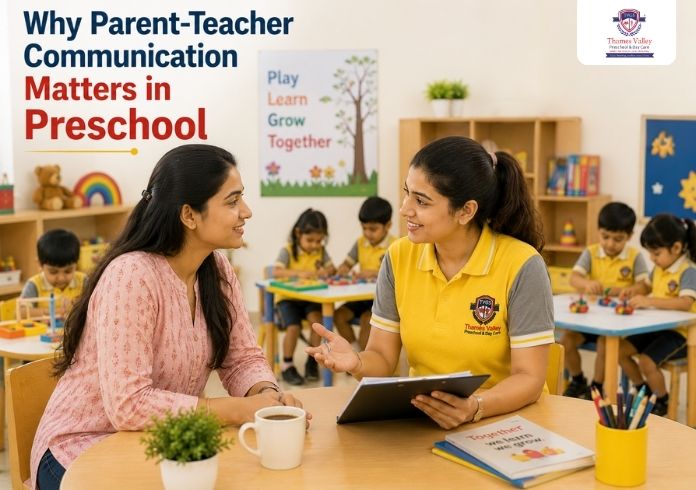
When parents choose a preschool, they scrutinise curriculum, safety and fees — and often overlook the factor that quietly shapes a child’s whole experience: the relationship between home and school. Strong parent-teacher communication in preschool is one of the biggest predictors of a happy, well-supported child. When parents and teachers work as a team, children feel secure, transitions go smoothly, and small issues get solved before they grow. Here’s why it matters and how to make it work.
Young children thrive on consistency
A three-year-old can’t yet explain their day, so parents and teachers become each other’s eyes and ears. When a teacher knows your child slept badly, and you know they had a wobble at snack time, both of you can respond with the right kind of care. That shared understanding creates the consistency between home and school that young children depend on to feel safe.
It supports your child’s development
Regular updates let you reinforce at home what’s happening in class — a new song, an emerging interest, a skill they’re practising. When learning flows both ways, children progress faster and feel that the adults in their life are genuinely on the same team. Teachers can also flag areas where a little extra support at home would help, long before they become concerns.
It catches concerns early
Whether it’s a friendship difficulty, a dip in appetite or a developmental question, problems are far easier to address when parents and teachers talk openly and often. Good communication turns “why didn’t anyone tell me?” into “we noticed this together and here’s what we’re doing.” That early, honest dialogue prevents small worries from turning into big ones.
It builds trust — and eases separation
When you trust your child’s teacher, you drop off with confidence — and your child feels that confidence. Anxiety is contagious, but so is reassurance. A parent who has an open, warm line to the teacher is a calmer parent, which makes for a calmer child. This is one reason strong communication smooths those tricky early weeks and the first day at preschool.
| TIP A preschool that welcomes your questions and updates you openly is showing you something important: it has nothing to hide and sees you as a partner, not a spectator. |
What good communication looks like
- Regular, honest updates on your child’s progress and well-being.
- An approachable, open-door attitude when you have a question or concern.
- Clear channels to reach a teacher without friction.
- Two-way sharing — teachers listen to parents as much as they inform them.
At Thames Valley we treat parents as partners in every child’s growth, because we’ve seen how much a strong home-school connection helps children flourish. It’s a quality worth actively looking for when you choose a school.
How parents can strengthen the partnership
Communication is a two-way street. Share useful context about your child, respond to the school’s updates, raise concerns early and kindly, and assume good intent. A warm, respectful partnership benefits the one person you both care about most. When you’re evaluating schools, make communication one of your questions to ask before choosing a preschool, and see our complete preschool admission guide for parents in India for the full picture.
Frequently asked questions
Q1 : How often should a preschool update parents?
Ans : There’s no fixed rule, but regular updates — plus easy access to a teacher when you have a concern — are the mark of a school that values partnership. Ask about this before you enrol.
Q2 : What should I do if I have a concern about my child?
Ans : Raise it early, directly and kindly with the teacher. Good preschools welcome open dialogue, and addressing concerns promptly usually resolves them quickly.
Q3 : Why does communication matter so much at preschool age?
Ans : Young children can’t fully explain their day, so parents and teachers rely on each other to understand and support the child. Consistency between home and school helps children feel secure.
Q4 : How often should parents communicate with preschool teachers?
Ans : Regular communication through meetings, daily updates, or school apps helps parents stay informed about their child’s progress and overall well-being.
Q5 : Can parent-teacher communication improve a child’s confidence?
Ans : Yes. When parents and teachers work together, children receive consistent support at home and school, which boosts confidence and emotional security.
| Visit Thames Valley PreschoolGive your child a joyful, safe and inspiring start. Book a campus visit to meet our teachers, see our safety systems, and find the right programme — from Mom & Me to UKG, plus post-school day care.
Enquire about admissions → https://thamesvalleyglobal.org/ |