


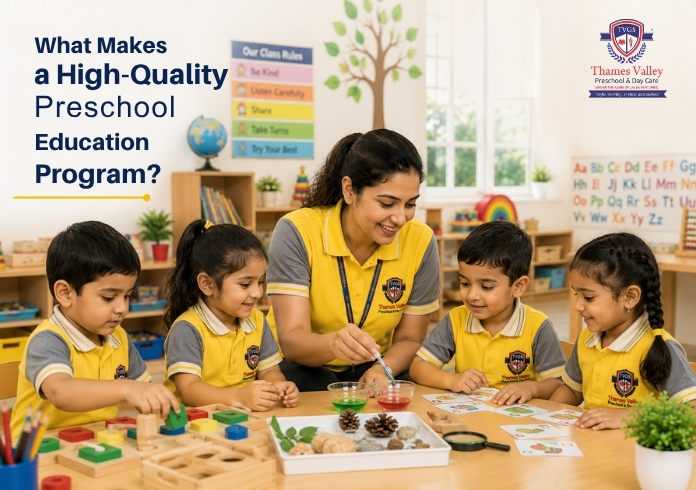
Every preschool describes itself as the best, so how do you tell genuine quality preschool education from clever marketing? The answer is that quality shows up in details that don’t fit on a banner — the training behind the teachers, the ratio of adults to children, the thought inside the curriculum, and the small daily habits that keep children safe, healthy and engaged. Once you know what to look for, good schools become surprisingly easy to spot.
A curriculum built around how young children learn
Children under six learn through play, senses and repetition — not worksheets. Play-Based Learning Supports Child Development by helping children build language, early numeracy, creativity, motor skills and social confidence through hands-on activities rather than rote learning.. Look for a curriculum that covers the whole child: cognitive skills, motor development, sensory perception, creativity and social-emotional growth. At Thames Valley our curriculum integrates languages, arts, numeracy, science and environmental awareness through interactive, scientifically designed learning, precisely because a narrow academic focus fails young children.
Well-trained, well-supported teachers
The teacher is the single biggest factor in the quality of any preschool. Warm, trained, patient teachers turn a room of nervous toddlers into a happy learning community. Ask how teachers are selected, how often they are trained, and whether the school invests in ongoing workshops. We select carefully and put our staff through regular training, seminars and structured evaluation — because a teacher who keeps growing keeps the classroom alive.
A sensible child-to-teacher ratio
Even a brilliant teacher cannot give thirty toddlers individual attention. A lower child-to-teacher ratio means more warmth, faster help, and safer supervision. There is no single magic number, but the smaller the group per adult, the more your child is seen as an individual rather than one of a crowd.
Safety and hygiene as non-negotiables
In quality preschools, safety is designed in, not bolted on. Look for secure access control, CCTV coverage, safe transport, and clear protocols for who can collect a child. Hygiene matters just as much for this age group:
- Clean, sanitised classrooms and washrooms.
- Safe drinking water and a healthy, junk-free food policy.
- Clear illness and emergency procedures.
- Secure entry, exit and pick-up authentication.
At Thames Valley these are baseline standards — 24/7 CCTV, live GPS tracking on transport, RFID and strict access control, alongside rigorous nutrition and hygiene rules with zero tolerance for junk food.
A warm, stimulating environment
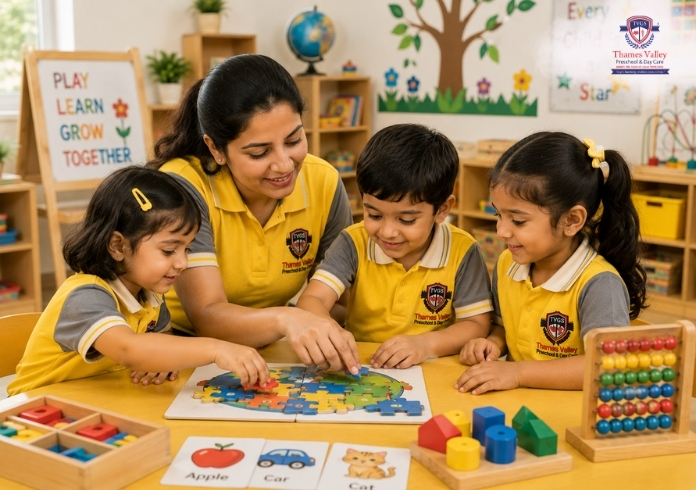
Walk into any classroom and you can feel the quality within a minute. Do children look engaged and relaxed? Are teachers speaking gently and getting down to the child’s level? Are there age-appropriate materials, displays of children’s own work, and space to move and explore? A rich, caring environment nurtures creativity and confidence far better than an impressive-looking building.
| TIP Quick test: a quality preschool feels warm before it looks impressive. Trust what you sense about the children and teachers over the marble in the lobby. |
Communication with parents
Strong programs treat parents as partners. Regular updates, an open-door attitude and honest conversations about your child’s progress are all signs of a school that has nothing to hide. We explore why this matters so much in our guide on parent-teacher communication in preschool.
Putting it all together
No school is perfect, but the best ones get the fundamentals right: a play-based curriculum, trained teachers, good ratios, real safety and hygiene, a warm environment, and open communication. For the full picture of choosing and applying, see our complete preschool admission guide for parents in India, and take our list of questions every parent should ask before choosing a preschool with you on every visit.
Frequently asked questions
Q1 : What is the most important sign of a quality preschool?
Ans : Teacher quality. Warm, well-trained teachers with a sensible child-to-teacher ratio matter more than facilities or branding, because they shape your child’s daily experience of learning.
Q2 : Is play-based learning better than academic preschool?
Ans : For children under six, yes. Play-based, experiential learning builds language, numeracy and social skills in a way young brains absorb naturally, whereas heavy rote work can dampen curiosity.
Q3 : How do I judge quality during a visit?
Ans : Watch the children and teachers. Engaged, relaxed children and calm, attentive teachers are the clearest signal — far more reliable than the building itself.
| Visit Thames Valley PreschoolGive your child a joyful, safe and inspiring start. Book a campus visit to meet our teachers, see our safety systems, and find the right programme — from Mom & Me to UKG, plus post-school day care.Enquire about admissions → https://thamesvalleyglobal.org/ |