


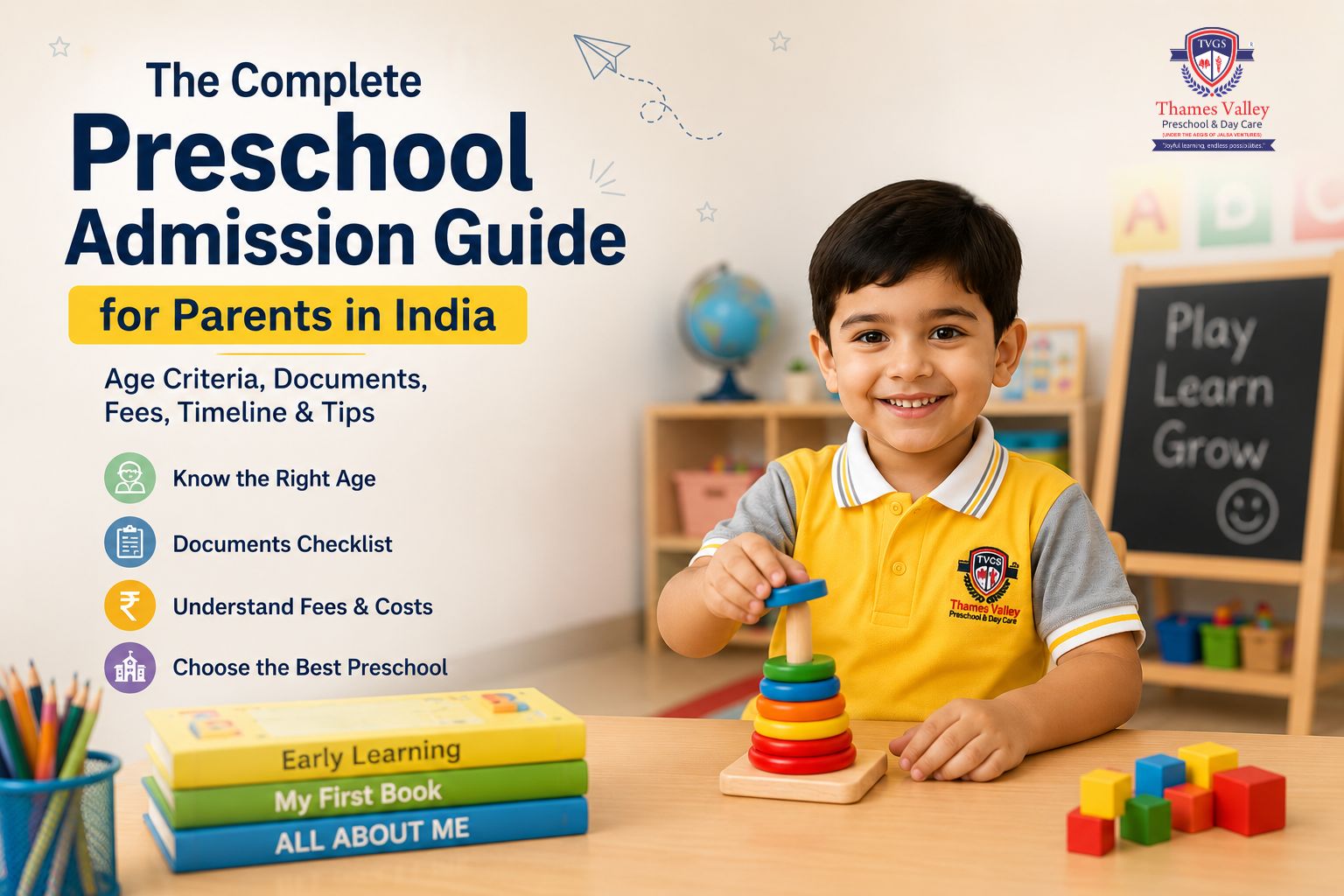
Choosing where your child spends their first years outside home is one of the most emotional decisions a parent makes — and in India, the preschool admission process can feel surprisingly competitive and confusing. Between play group, nursery, LKG and UKG terminology, varying age cut-offs across states, long waitlists at popular schools, and a document checklist that seems to grow every year, it is easy to feel overwhelmed. This guide walks you through the entire journey in plain language, so you can approach preschool admission with a clear plan instead of last-minute panic.
At Thames Valley Preschool, we meet hundreds of first-time parents every admission season, and the same questions come up again and again. We have gathered the most useful answers here — from when to start applying to what actually happens on a campus visit — and linked out to detailed guides on each topic so you can go deeper wherever you need to.
What counts as “preschool” in India?
Preschool (also called playschool or early years) refers to structured early education before formal Class 1. In most Indian schools the preschool years are organised into a familiar ladder, and understanding it helps you apply for the right stage:
- Mom & Me / Toddler (around 1–2 years): a gentle first separation, heavy on sensory play and motor skills.
- Play Group (around 2–3 years): daily-life skills, early language and social routines.
- Nursery (around 3–4 years): pre-reading, pre-writing and pre-number readiness.
- LKG — Lower Kindergarten (around 4–5 years): structured literacy and numeracy foundations.
- UKG — Upper Kindergarten (around 5–6 years): the bridge into formal Class 1.
At Thames Valley we run all of these stages plus a supervised post-school Day Care, so children can move up through a consistent curriculum and familiar teachers rather than switching schools every year — which matters more for young children than most parents expect.
When should you start the preschool admission process?
Timing is the single biggest source of stress in Indian preschool admissions. Most schools follow an academic year that begins in April, and the admission window for popular preschools typically opens between November and January of the preceding year. Sought-after schools fill their seats early, so the practical rule is simple: start researching a full year before you want your child to join.
| TIP Rule of thumb: begin shortlisting schools 10–12 months before the intended start date, book campus visits 6–8 months ahead, and submit applications as soon as the admission window opens. |
If you are relocating or your city has a mid-year intake, ask each school directly about rolling admissions. Many good preschools keep a few seats open through the year, especially in play group where families move often.
Preschool admission age criteria
Age eligibility is where parents get tripped up most, because there is no single national rule for preschool. Cut-off dates vary by state and even by school, and some states have tightened minimum-age norms for nursery and Class 1 in recent years. Rather than assume, always confirm the exact cut-off date with the specific school. As a general guide, children are usually placed by their completed age as of a fixed date (often 31 March or 1 June depending on the school).
If your child falls right on the borderline, don’t decide on age alone — readiness matters just as much. We cover the practical signs to look for in our guide on the signs your child is ready for preschool, which many parents find more reassuring than a date on a calendar.

Documents you’ll need for preschool admission
Requirements vary, but almost every Indian preschool asks for some version of this list. Keeping scans and photocopies ready in one folder saves a lot of scrambling once the window opens:
- Child’s birth certificate (the primary age proof).
- Passport-size photographs of the child and both parents.
- Address proof (Aadhaar, utility bill, rent agreement or passport).
- Child’s and parents’ Aadhaar cards, where requested.
- Immunisation / vaccination record.
- Recent medical fitness note or blood group information, if asked.
Keep a physical folder and a digital copy on your phone. Some schools now accept online applications, so having clean scans ready makes the process far smoother.
Understanding preschool fees
Preschool fees in India vary widely by city, curriculum and facilities. When you compare schools, look past the headline number and ask for the full fee structure so you can compare like with like:
- One-time admission or registration fee.
- Term or annual tuition fee and how it is split.
- Optional add-ons: transport, meals, day care, and activity or material charges.
- The refund policy if you withdraw before the year starts.
A lower sticker price is not automatically better value. What you are really paying for is teacher quality, safety infrastructure, and the daily experience your child has — which is why a campus visit tells you far more than a fee sheet ever will.
How to choose the right preschool
Once you understand the mechanics of admission, the real work begins: choosing well. A good preschool shapes how your child feels about learning for years to come, so it is worth being deliberate. The factors that matter most are safety, teacher quality, curriculum, ratio of children to teachers, hygiene, and the warmth of the environment.
At Thames Valley Preschool we built our campuses around exactly these priorities — 24/7 CCTV surveillance, live GPS tracking on transport, RFID and strict access control, a zero-tolerance policy on junk food, and teachers who are trained and re-evaluated to international standards. But you shouldn’t take any school’s word for it, including ours. Visit, observe, and ask questions.
Because choosing well has so many moving parts, we’ve written detailed companion guides for each part of the decision. Use them as a set:
- How to prepare your child for preschool admission — settling nerves and building independence before day one.
- What makes a high-quality preschool education program — the markers of real quality versus marketing.
- Preschool vs day care: which one is right for your child — understanding the difference before you decide.
- Signs your child is ready for preschool — readiness cues that matter more than age.
- Questions every parent should ask before choosing a preschool — the checklist to take to every school.
- How to make your child’s first day at preschool stress-free — a calm, practical plan for the big day.
- Common mistakes parents make while choosing a preschool — so you can avoid them.
- Why parent-teacher communication matters in preschool — the factor parents most often overlook.
- What to look for during a preschool campus visit — turning a tour into a real evaluation.
A simple preschool admission timeline
- 12 months before: list your priorities and shortlist 4–6 schools near home or work.
- 8 months before: book and attend campus visits; observe a live class if allowed.
- 6 months before: narrow to 2–3 favourites and confirm age cut-offs and fees.
- When the window opens: submit applications with all documents ready.
- After acceptance: pay to confirm the seat, then start gently preparing your child.
- The week before: do a settling-in visit, sort logistics, and keep goodbyes calm.
Frequently asked questions
Q1 : What is the right age for preschool admission in India?
Ans : Most children begin play group around 2–3 years and nursery around 3–4 years, but cut-off dates vary by state and school. Always confirm the exact age criteria with the specific preschool, and weigh your child’s readiness alongside their age.
Q2 : When should I apply for preschool admission?
Ans : Begin researching about a year ahead. Admission windows for the April academic year often open between November and January, and popular schools fill quickly, so apply as soon as the window opens.
Q3 : What documents are needed for preschool admission?
Ans : Typically the child’s birth certificate, photographs, address proof, Aadhaar (where asked), and an immunisation record. Keep both physical copies and digital scans ready before applications open.
Q4 : How do I choose the best preschool for my child?
Ans : Prioritise safety, teacher quality, hygiene, curriculum and the child-to-teacher ratio, then visit in person. A campus visit and a good set of questions reveal far more than any brochure.
| Visit Thames Valley PreschoolGive your child a joyful, safe and inspiring start. Book a campus visit to meet our teachers, see our safety systems, and find the right programme — from Mom & Me to UKG, plus post-school day care.
Enquire about admissions → https://thamesvalleyglobal.org/ |