



Writing is one of the most complex fine motor tasks for a young child. Before being able to write, a whole foundation of small-muscle skills has to be functioning. Understanding this connection helps you prepare your child for writing the right way — through hands that are ready, not through pressure. How Fine Motor Skills Help Preschoolers With Writing and Drawing is closely connected to developing pencil control, hand strength, coordination, and confidence. Here’s how fine motor skills help with writing.
Why Writing Depends on Fine Motor Skills
Writing is the result of several skills working in tandem. To form a letter, a child must hold a pencil with a controlled grip, apply the correct pressure, move it in precise directions, and coordinate these activities with what their eyes see. Every one of those is a fine motor as well as a visual-motor skill.
This is why fine motor development is inherently tied to writing readiness. Occupational therapists note that fine motor skills lay the foundation to writing and are a major focus of the preschool years (The OT Toolbox). A child whose hands aren’t ready yet will find writing too difficult – not because they are not smart, but because the physical foundation is not in place.
The Specific Skills Behind Handwriting
Several distinct fine motor abilities work together to make writing happen:
Pencil grip. The mature “tripod grasp” (thumb, index, and middle finger) gives the control writing requires. This grip develops from the pincer grasp children build as toddlers.
Hand strength. Forming letters and writing for any length of time requires patience and stamina. Weak hands tire fast, and so often a child might start neatly and fade quickly.
In-hand manipulation. The subtle ability to adjust a pencil within the hand by rotating it, shifting it and without dropping it lets a child reposition their grip smoothly.
Bilateral coordination. Writing is a two-handed job: one hand writes while the other hand steadily holds the paper. This teamwork is a fine motor skill in itself.
Visual-motor integration (hand-eye coordination). The eyes guide the hand to form shapes accurately and stay on the line. This is covered in How Hand-Eye Coordination Develops.
If you’re looking for more practical ways to support your child’s hand strength and coordination, explore our guide on Fine Motor Skills in Preschoolers: 12 Fun Activities at Home.
Why You Shouldn’t Rush Straight to Letters
Many well-meaning parents miss a crucial insight. As writing depends on all these underlying skills, pushing formal letter-writing before the foundation is ready is often counterproductive — causing frustration and poor grip habits and may lead to the child disliking writing.
Occupational therapists and early educators advise building the foundation first: letting the child draw drawing the basic strokes that letters are made of (vertical lines, horizontal lines, circles, crosses) before attempting letters. Most children aren’t ready for formal letter instruction until after age four, and only once their drawing skills are in place — rushing to letters before drawing skills are ready skips the foundation (Bridging Child Development).
In other words: strong hands and confident drawing develop before neat letters. By getting the order right, writing becomes far easier.
How Drawing Builds Writing
Drawing isn’t just a good pastime — it mimics writing practice. When a child draws, he is building pencil control and learning to make deliberate marks, and develops the visual-motor skills that letters demand.
The progression is natural: scribbles become controlled lines, lines become shapes, shapes become the strokes of letters. A child who draws a lot of circles, lines, faces and pictures is actually rehearsing every movement handwriting will require later. This is why the pre-writing activities that focus on shapes and strokes are so crucial to developing writing abilities.
How to Build Writing-Ready Hands at Home
Strong, coordinated hands, instead of just worksheets, are required to build writing ready hands:
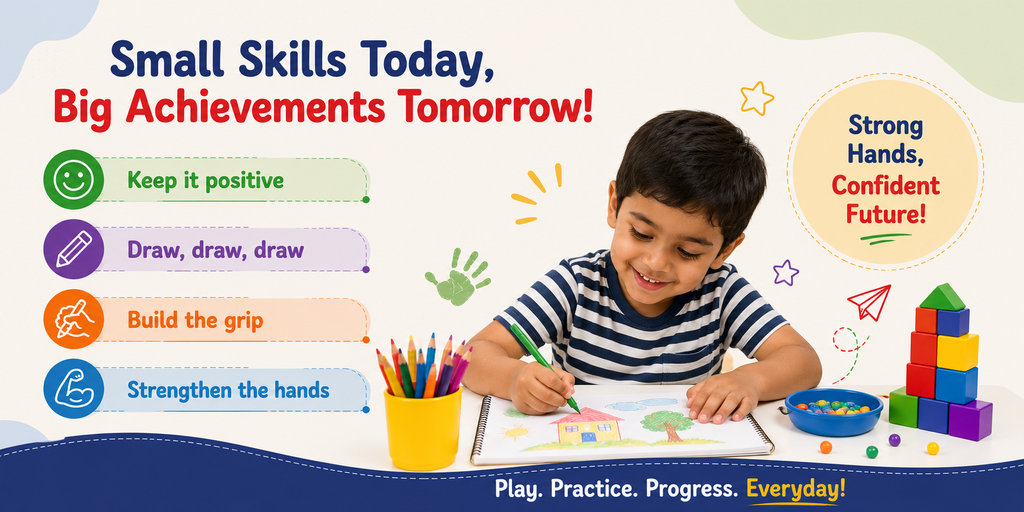
- Strengthen the hands: playdough, spray bottles, clothes and pegs all build the strength that writing demands.
- Practise the strokes: tracing lines and shapes in sand, drawing on vertical surfaces and copying simple shapes.
- Build the grip: activities that utilise the pincer grasp such as threading, tongs and picking up small beads develop the fingers to hold a pencil.
- Draw, draw, draw: encourage lots of drawing freely, as it is an excellent writing preparation.
- Keep it positive: a child who enjoys mark-making will approach writing with confidence rather than frustration
.
Looking for age-appropriate activities? Explore our fine motor activities for 4-year-olds and 5-year-old children to help build the hand strength, coordination, and control needed for writing and drawing.
Why This Matters Beyond Neat Handwriting
There’s another reason to get this right. When handwriting is physically hard, a child spends all their mental energy just writing basic letters, leaving little time left for what they want to write. However, when writing feels comfortable and automatic, children can focus on their ideas and their learning. Strong fine motor foundations produce neat writing and also free up a child to think and express themselves. This explains why fine motor skills are linked to broader academic outcomes.
The Key Takeaway
Writing is a complex fine motor skill that uses grip, hand strength, coordination, and is the result of a lot of drawing practice. Understanding How Fine Motor Skills Help Preschoolers With Writing and Drawing can help parents support these essential skills naturally. The smartest way to prepare your preschooler for handwriting isn’t through making them write letters but by building strong, coordinated hands through play and letting drawing lay the groundwork for their writing skills. Parents looking for the right learning environment can also explore preschool admission options that encourage creativity, play-based learning, and overall child development. By building the right foundation, writing can become an activity that your child enjoys as a hobby.
For some activities that build pencil control in children, see Best Pre-Writing Activities for Preschoolers
Want to understand the basics first? Read our guide on What Are Fine Motor Skills? to learn how these skills support children’s everyday learning and development.
FAQ’s ( Frequently Asked Question )
Q1: How do fine motor skills affect writing?
Ans: Fine motor skills support pencil grip, hand strength, finger control, and hand-eye coordination, making it easier for preschoolers to control a pencil and form letters.
Q2: Should I teach my preschooler to write letters early?
Ans:: It is better to build basic fine motor skills first through drawing, tracing, and simple strokes. Once a child develops enough control, they can gradually begin practising letters.
Q3: How does drawing help with writing?
Ans:: Drawing strengthens pencil control and visual-motor coordination. Lines, circles, and shapes gradually help children develop the movements needed for writing letters.
Q4: What fine motor skills are needed for writing?
Ans:: Children need finger strength, wrist stability, pencil control, hand-eye coordination, and the ability to move and adjust a pencil using their fingers.
Q5: What activities improve fine motor skills for writing?
Ans:: Drawing, colouring, tracing, cutting with child-safe scissors, playing with playdough, threading beads, using tweezers, and building with small blocks can help develop these skills.
Q6: Does colouring help preschoolers prepare for writing?
Ans:: Yes. Colouring encourages children to control pencil or crayon movements, stay within boundaries, and strengthen the small muscles in their hands and fingers.
Q7: When should preschoolers start practising writing?
Ans:: Children can begin with pre-writing activities such as scribbling, drawing lines, circles, curves, and simple shapes. Formal letter writing can be introduced gradually when they show sufficient readiness.
Q8: Why is pencil grip important for preschool writing?
Ans:: A comfortable and functional pencil grip allows children to control their writing movements more effectively and reduces unnecessary hand fatigue during drawing and writing.
Q9: Can fine motor activities improve a child’s handwriting?
Ans:: Regular fine motor activities can improve hand strength, coordination, and pencil control, which provide important foundations for developing clearer and more controlled handwriting.
Q10: How can parents develop fine motor skills at home?
Ans:: Parents can include simple activities such as drawing, puzzles, playdough, bead threading, tearing and pasting paper, colouring, and tracing in everyday play to strengthen fine motor skills naturally.