


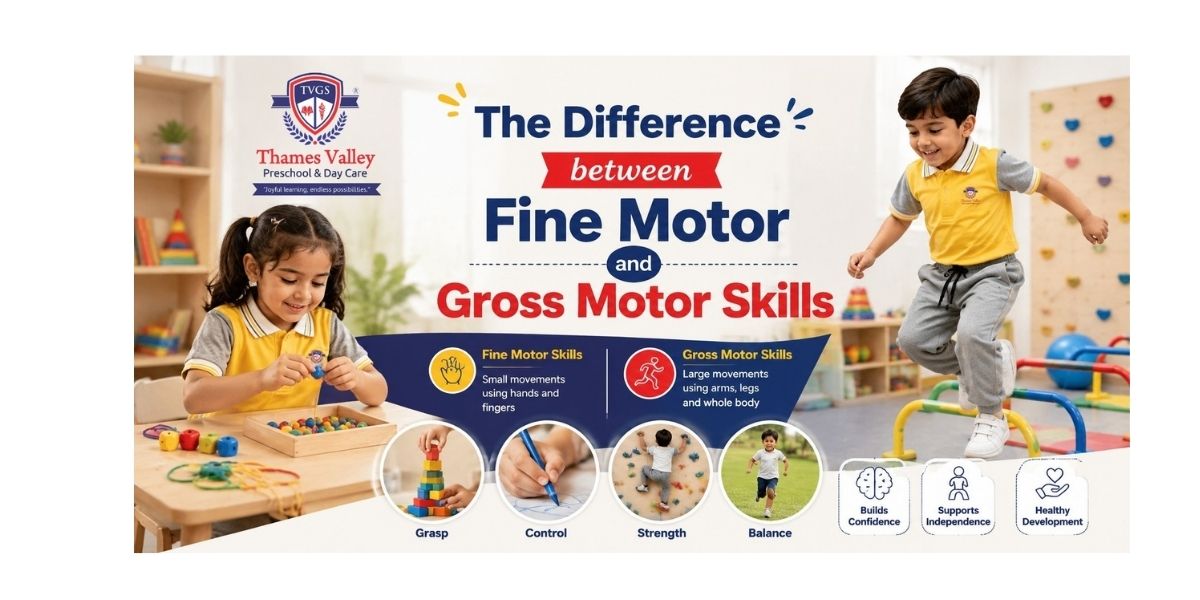
In the world of child development, the terms “fine motor” and “gross motor” are often used when talking about how children learn to move and control their bodies. Although the two may sound similar, they refer to different types of movements and skills. Understanding The Difference between Fine Motor and Gross Motor Skills can help parents and teachers better understand a child’s physical development and recognize how different activities support their growth.
Here’s a simple explanation of how fine motor and gross motor skills differ and why both are important during the early years.
The Difference
The difference depends upon muscle size:
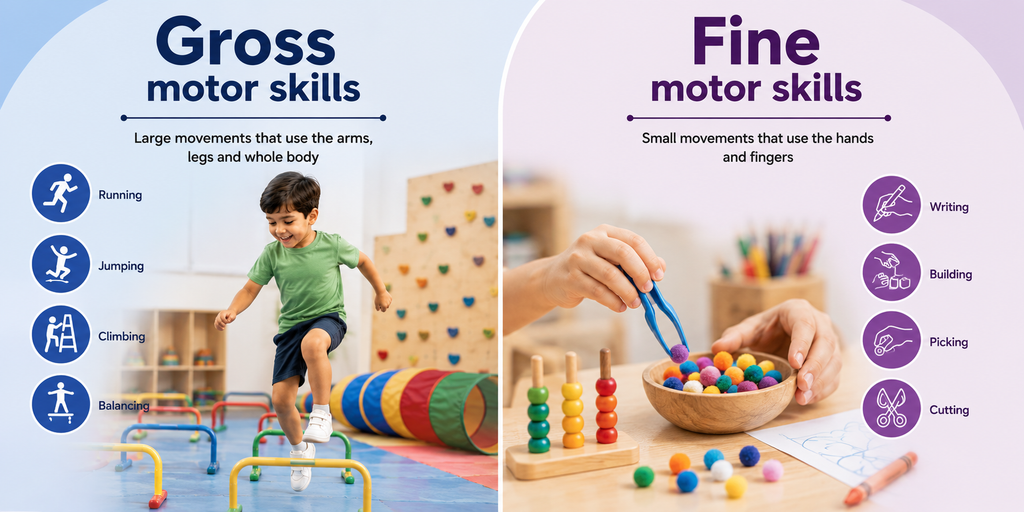
Gross motor skills use the large muscles of the body such as arms, legs and torso for whole-body movements such as running, jumping, climbing, throwing and pedalling a tricycle.
Fine motor skills use the small muscles of the hands, fingers, and wrists for small, precise movements. Holding a pencil, using scissors, buttoning a shirt, and picking up a bead are all fine motor skills.
A Side-by-Side Comparison
In practice, they differ in the following ways:
Muscles used: Gross motor movements use large muscles in the body located in areas such as arms and legs, while fine motor movements use small muscles such as those in the hands, fingers and wrists.
Example movements: Gross motor skills encompass movements such as running, jumping, climbing and throwing a ball, while fine motor skills involve movements such as writing, cutting, threading beads and closing buttons.
Development: Gross motor skills generally develop earlier, while fine motor skills develop later and more gradually.
Everyday role: Gross motor skills are used in moving around, playing sport and in physical confidence, while fine motor skills are utilised in self-care, writing, classroom tasks, and personal independence.
The Important Connection: Big Muscles Support Small Ones
Most parents do not realise that gross motor strength is the foundation for fine motor control.
This implies that a stable, strong centre (shoulders, core) is required before controlled, precise movements at the extremities (hands, fingers) can be made. For example, to control a pencil, a stable shoulder and strong core to hold steady their body and arms is required, otherwise the fingers have no solid holding to work. Therefore, activities like crawling and climbing build the shoulder and core strength that supports neat handwriting.
Why Both Matter for Preschoolers
Both types of skill are essential to performing activities and develop hand in hand.
Gross motor skills give children physical confidence, the ability to play, and the core strength that supports other activities. An active child who utilises his gross motor skills well is building the base upon which fine motor skills depend.
Fine motor skills give children independence and ready them for school by providing them with the ability to write, cut, dress up, and manage classroom activities.
READ MORE – What Makes a High-Quality Preschool Education Program?
Supporting Both Skills at Home
Luckily, both motor skills are easy to nurture at home through play.
For gross motor skills: climbing frames, running games, ball play, dancing, balancing on a line, crawling like a bear, hopping like a frog, and playground time which involve various physical activities help.
For fine motor skills: playdough, building blocks, threading, cutting, drawing, and the activities in our age-by-age guides all build the small muscles.
An important truth: many childhood activities naturally build both fine motor and gross motor skills at once, such as climbing a frame and then making a chalk drawing at the top and a nature walk followed by threading the collected leaves involve whole-body play and hand play working together.
The Key Takeaway
Fine and gross motor skills are similar to two sides of the same coin. The Difference between Fine Motor and Gross Motor Skills becomes clearer when we understand that gross motor skills use the big muscles for whole-body movements, while fine motor skills use smaller muscles for precise hand and finger movements. Importantly, big-muscle strength provides the foundation for small-muscle control, which is why children benefit from activities such as climbing, jumping, drawing, and writing. Parents can introduce 12 Home-Based Fine Motor Activities for 5-Year-Old Children through simple, playful tasks that strengthen hand control, coordination, and concentration. By supporting both types of movement through play, parents can help build a strong foundation for confident writing, learning, and independence. When choosing a preschool, parents can also consider how these skills are encouraged through daily activities before making an admission decision.
FAQ’s ( Frequently Asked Question )
Q1: What is the difference between fine and gross motor skills?
Ans: Gross motor skills involve large muscles and whole-body movements such as running, jumping, climbing, and balancing. Fine motor skills use smaller muscles in the hands and fingers for activities such as writing, drawing, buttoning clothes, and picking up small objects.
Q2: Which motor skill develops first?
Ans: Gross motor skills generally develop before fine motor skills. Children first gain control over larger movements, such as sitting, crawling, and walking, which later provide the strength and stability needed for more precise hand movements.
Q3: Can gross motor activities improve fine motor skills?
Ans: Yes. Activities such as climbing, crawling, swinging, and throwing can strengthen the shoulders, arms, and core. This strength helps children develop better control for fine motor activities like drawing, writing, and building with blocks.
Q4: What are some examples of fine motor skills in children?
Ans: Fine motor skills include holding a pencil, turning pages, using scissors, picking up small objects, buttoning clothes, using utensils, and tying shoelaces. These activities require coordination and control of the hands and fingers.
Q5: What are some examples of gross motor skills in children?
Ans: Running, jumping, hopping, climbing, kicking a ball, balancing, skipping, and riding a tricycle are common examples of gross motor skills. These movements involve larger muscle groups and help children develop strength and coordination.
Q6: Why are fine motor skills important for preschool children?
Ans: Fine motor skills help children perform everyday tasks independently and prepare them for school activities. Skills such as holding a pencil, using scissors, drawing, and managing buttons are important for classroom participation and self-care.
Q7: Why are gross motor skills important in early childhood?
Ans: Gross motor skills help children build strength, balance, coordination, and body awareness. They also make it easier for children to participate confidently in active play, sports, and everyday physical activities.
Q8: How can parents develop fine motor skills at home?
Ans: Parents can encourage activities such as drawing, colouring, puzzles, clay modelling, threading beads, building with blocks, and using child-safe scissors. Simple everyday tasks like opening containers or using a spoon can also strengthen hand coordination.
Q9: How can parents improve gross motor skills at home?
Ans: Children can practise gross motor skills through activities such as jumping, dancing, crawling, playing catch, climbing safely, balancing on one foot, and creating simple obstacle courses. Outdoor play is also a great way to encourage active movement.
Q10: Do fine and gross motor skills develop at the same rate?
Ans: No. Every child develops motor skills at their own pace. Some children may become confident with running and climbing early, while others may show stronger fine motor abilities first. Regular opportunities for both types of movement can support overall development.
How Fine Motor Skills Help Preschoolers With Writing and Drawing
September 1, 2026[…] to understand the basics first? Read our guide on What Are Fine Motor Skills? to learn how these skills support children’s everyday learning and […]