



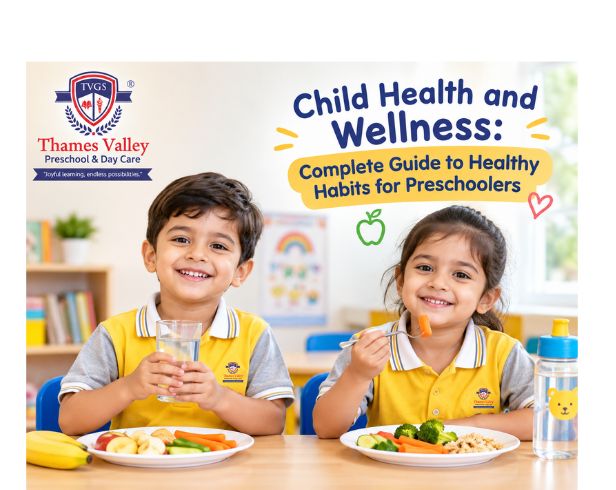
Every family with a young child knows how important it is to monitor their child’s health and routines around eating, movement, sleep, hygiene and self-care. This guide on child health and wellness provides a complete guide to healthy habits for preschoolers and explains how parents can emulate health habits at home to support their child’s health.
Why the Preschool Years Matter for Health
During early childhood, routines around food, movement, sleep, hygiene and self-care begin to assume importance. To build a good routine, it should be followed naturally and interlinked with normal family life instead of being modulated as rigid rules. As young children become more independent, simple habits such as washing hands and putting on shoes begin to form a part of their routine. Parents can support their children by helping them build good habits in early childhood that support their health and development, and can coordinate with their children’s educators for this.
Build Habits Through Routine, Not Pressure
Habits are best built through repetition instead of coercion. An easy-to-follow routine which includes – waking up, washing, having breakfast, actively playing, having meals, quiet time and bedtime – simplifies decision making for the child. Parents can encourage healthy patterns over days and weeks, and find out what makes the routine easier and adjust it as the child matures. It is important to provide a child with a supportive environment, instead of judgment and comparison with other children.
Food, Movement, Sleep and Hydration Work Together
To ensure a child’s wellness, make sure that the parent understands that the child’s sleep, food, movement and hydration are interconnected. Parents should focus at the whole pattern behind physical activity, sedentary behaviour and sleep across a 24-hour day. They should observe what makes the routine easier and adjust expectations as the child develops. The objective is to have a supportive environment.
Healthy Habits at Home and Preschool
The same habits should be followed both at home and preschool to make the routine stick with children. As part of Child Health and Wellness: Complete Guide to Healthy Habits, parents should enquire about how their child has had meals, taken water breaks, washed their hands, played outdoors, and rested during the day, and then follow a similar routine at home. Their child’s preschool can also reinforce these healthy routines at home.
When to Seek Individual Advice
Children have different appetite, sleep, growth, sensory preferences and activity levels. A pediatrician should be consulted if a child displays persistent feeding difficulty, poor growth, unusual thirst, sleep problems or concerns around development. Advice based on a blog should not be used to diagnose a child.
How Thames Valley Preschool Fits Into the Conversation
Thames Valley Preschool provides a child-centered environment with opportunities for the child to develop his physical, social, emotional and intellectual development. Families can inquire how relevant routine and developmental area is supported at their local center.
The Key Takeaway
Parents and preschools can actively help children develop healthy daily routines by creating repeated opportunities to practice them and observing each child’s response. Our center encourages children to build age-appropriate healthy habits through everyday activities and routines. In case of any concerns, parents should discuss them with a qualified healthcare professional rather than relying solely on blog articles..
FAQs
Q1: Why is child health and wellness important during the preschool years?
Ans: Preschool years are an important stage for developing healthy habits, communication, movement, independence, and social-emotional skills. Consistent routines can support a strong foundation for overall wellbeing.
Q2: What healthy habits should preschoolers learn?
Ans: Preschoolers can gradually learn habits such as eating nutritious foods, drinking enough water, washing their hands, getting enough sleep, staying physically active, and maintaining good personal hygiene.
Q3: How much physical activity does a preschooler need?
Ans: Preschoolers benefit from regular active play throughout the day. Running, jumping, dancing, outdoor games, and age-appropriate physical activities can support movement and coordination.
Q4: Why is healthy nutrition important for preschool children?
Ans: A balanced diet provides children with nutrients and energy needed for growth, learning, activity, and everyday development. Offering a variety of fruits, vegetables, whole grains, and other nutritious foods can help build healthy eating habits.
Q5: How important is sleep for preschoolers?
Ans: Good sleep supports children’s growth, learning, mood, energy, and daily functioning. A consistent bedtime routine can help children develop healthy sleep habits.
Q6: How can parents encourage good hygiene habits in preschoolers?
Ans: Parents can teach hygiene through simple daily routines such as washing hands before meals and after using the toilet, brushing teeth, bathing regularly, and keeping personal belongings clean.
Q7: How can preschoolers develop healthy social-emotional habits?
Ans: Children can develop these skills through play, conversations, sharing, taking turns, expressing feelings, and learning how to communicate their needs respectfully.
Q8: Should every preschooler develop at exactly the same pace?
Ans: No. Children differ in temperament, experiences, environment, and developmental pace. Developmental milestones can be useful references, but individual differences are normal.
Q9: How can parents and preschool work together to support child wellness?
Ans: Parents and preschool educators can share observations, discuss routines, and work on practical goals together. Consistent approaches at home and preschool can make healthy habits easier for children to follow.
Q10: When should parents seek professional advice about a child’s health or development?
Ans: Parents should consider seeking professional advice when a concern is persistent, affects the child’s daily life, or raises concerns about their health, safety, growth, or development. A qualified healthcare professional can provide guidance based on the child’s individual needs.
References
1. WHO—Guidelines on physical activity, sedentary behaviour and sleep for children under 5: https://www.who.int/publications/i/item/9789241550536
2. CDC—Developmental Milestones: https://www.cdc.gov/act-early/milestones/
3. NAEYC — Developmentally Appropriate Practice: https://www.naeyc.org/resources/position-statements/dap/principles
4. NAEYC—The Power of Playful Learning: https://www.naeyc.org/resources/pubs/yc/summer2022/power-playful-learning
5. UNICEF—Care for Child Development: https://www.unicef.org/documents/care-child-development
6. NHS—Sleep and young children: https://www.nhs.uk/baby/health/sleep-and-young-children/
7. NHS—Separation anxiety: https://www.nhs.uk/baby/babys-development/behaviour/separation-anxiety/
8. Thames Valley Preschool — https://www.unicef.org/documents/care-child-development
9. Thames Valley Preschool — Admissions: https://thamesvalleyglobal.org/admission/
Healthy Food for Preschoolers: Nutrition, Meals, Snacks and
October 5, 2026[…] This article is a part of Thames Valley Preschool’s guide on child health and wellness. […]
Hydration for Preschoolers: How Much Water Children Need an
October 8, 2026[…] article is part of Thames Valley Preschool’s parent learning hub on child health and […]