


Healthy Habits for Preschoolers matters because preschool years are important for forming habits around eating, movement, sleep, hygiene and self-care. This guide focuses on habits that parents can repeat at home and coordinate with the preschool.
This article is a part of Thames Valley Preschool’s guide on child health and wellness.
Building a Balanced Preschool Plate
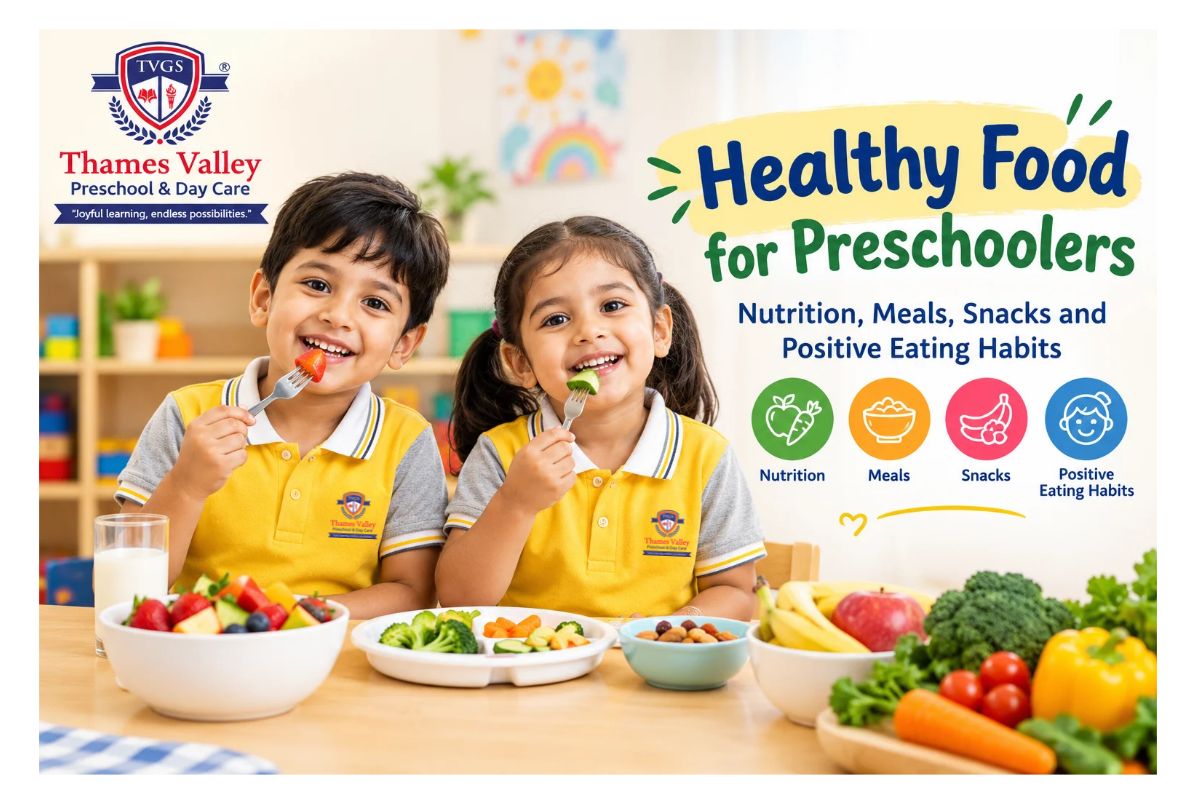
Children should have varied meals, with vegetables and fruit, grains or other starchy foods, protein rich foods and suitable dairy alternatives. Offer new foods gradually, without forcing the child to eat them. Naturally exposing your child to new foods provides them with opportunities to become familiar with them.
Picky Eating Without Mealtime Battles
Preschoolers naturally tend to be picky eaters. Parents can decide which foods should be offered, while the child should be in control of how much to eat. Children should be involved in washing produce, stirring, serving and selecting from two nutritious options.
Why the Preschool Years Matter for Health
Everyday patterns around food, movement, sleep, hygiene and self-care begin to be formed around early childhood. Good routines are best ingrained in children when they are pressure free and not presented as rules to be followed strictly. Letting preschoolers take simple responsibilities such as washing hands, helping choose fruit, putting on shoes, etc., can turn health into a skill they participate in.
Build Habits Through Routine, Not Pressure
Young children learn best through modelling and a predictable sequence. A good, predictable sequence reduces the amount of decision-making required from a child, and normalizes healthy behaviour.
Food, Movement, Sleep and Hydration Work Together
A child who is physically tired may be irritable at sleep, while a child who spends long periods sedentary may find it difficult to fall asleep at bedtime. Parents should look at the whole pattern of physical activity, sedentary behaviour and sleep across a 24-hour cycle.
Practical Ideas Parents Can Try This Week
Parents can try to implement one routine to make the day more predictable, offer water at specific times during the day, include active outdoor play and use short, repeatable bedtime sequences.
How Thames Valley Preschool Fits Into the Conversation
Thames Valley Preschool provides a child-centered environment with physical, social, emotional and intellectual development with age specific preschool programmes. We focus on holistic growth of the child, and provide valuable guidance to the parents on health and wellbeing.
The Key Takeaway
Healthy Food for Preschoolers is important for a child’s holistic development. At our center, parents should create repeated opportunities to practice and develop healthy routines. If there are any concerns, seek individual professional advice rather than relying on online guidance.
FAQ
Q: Why is healthy food for preschoolers important in the preschool years?
A: The preschool years are important for developing habits, communication, independence and social-emotional skills. Creating useful routines during this period forms the foundations for later learning and wellbeing.
Q: Should every preschooler develop at exactly the same pace?
A: No. Children differ in their temperaments, experiences and developmental pace. Continuing concerns and loss of previously acquired skills should be remedied with the help of a professional.
Q: How can parents and preschool work together?
A: Preschool and parents can work together by sharing relevant routines, using consistent language and focusing on small number of practical goals, rather than expecting identical behaviour across settings.
Q: When should parents seek professional advice?
A: Parents should seek advice when a concern is continuing over an extended period, involves health or safety or interferes with daily life.
Q: What are some healthy habits for preschoolers?
A: Healthy habits for preschoolers include eating nutritious meals, drinking enough water, getting adequate sleep, staying physically active, maintaining personal hygiene and following a consistent daily routine.
Q: How much physical activity do preschoolers need?
A: Preschoolers benefit from regular active play throughout the day. Activities such as running, jumping, dancing, outdoor games and playground play can support physical development, coordination and overall wellness.
Q: Why is sleep important for preschool children?
A: Good sleep supports children’s physical growth, learning, attention, mood and emotional wellbeing. A consistent bedtime routine can help preschoolers develop healthy sleep habits.
Q: How can parents encourage healthy eating habits in preschoolers?
A: Parents can encourage healthy eating by offering a variety of fruits, vegetables, whole grains and other nutritious foods. Eating together as a family and allowing children to make simple healthy choices can also support positive habits.
Q: How can preschoolers learn good hygiene habits?
A: Children can learn hygiene through simple routines such as washing their hands, brushing their teeth, covering their mouth when coughing and keeping their personal belongings clean. Adults can demonstrate these habits and provide gentle reminders.
Q: How does emotional wellbeing affect child health and wellness?
A: Emotional wellbeing is an important part of child health and wellness. Providing children with a safe, supportive environment where they can express feelings, build relationships and develop confidence can contribute to their overall wellbeing.
Sources / Editorial References
WHO — Guidelines on physical activity, sedentary behaviour and sleep for children under 5: https://www.who.int/publications/i/item/9789241550536
CDC — Developmental Milestones: https://www.cdc.gov/act-early/milestones/
NAEYC — Developmentally Appropriate Practice: https://www.naeyc.org/resources/position-statements/dap/principles
NAEYC — The Power of Playful Learning: https://www.naeyc.org/resources/pubs/yc/summer2022/power-playful-learning
UNICEF — Care for Child Development: https://www.unicef.org/documents/care-child-development
NHS — Sleep and young children: https://www.nhs.uk/baby/health/sleep-and-young-children/
NHS — Separation anxiety: https://www.nhs.uk/baby/babys-development/behaviour/separation-anxiety/
Thames Valley Preschool — Official website: https://thamesvalleyglobal.org/
Thames Valley Preschool — Admissions: https://thamesvalleyglobal.org/admission/