


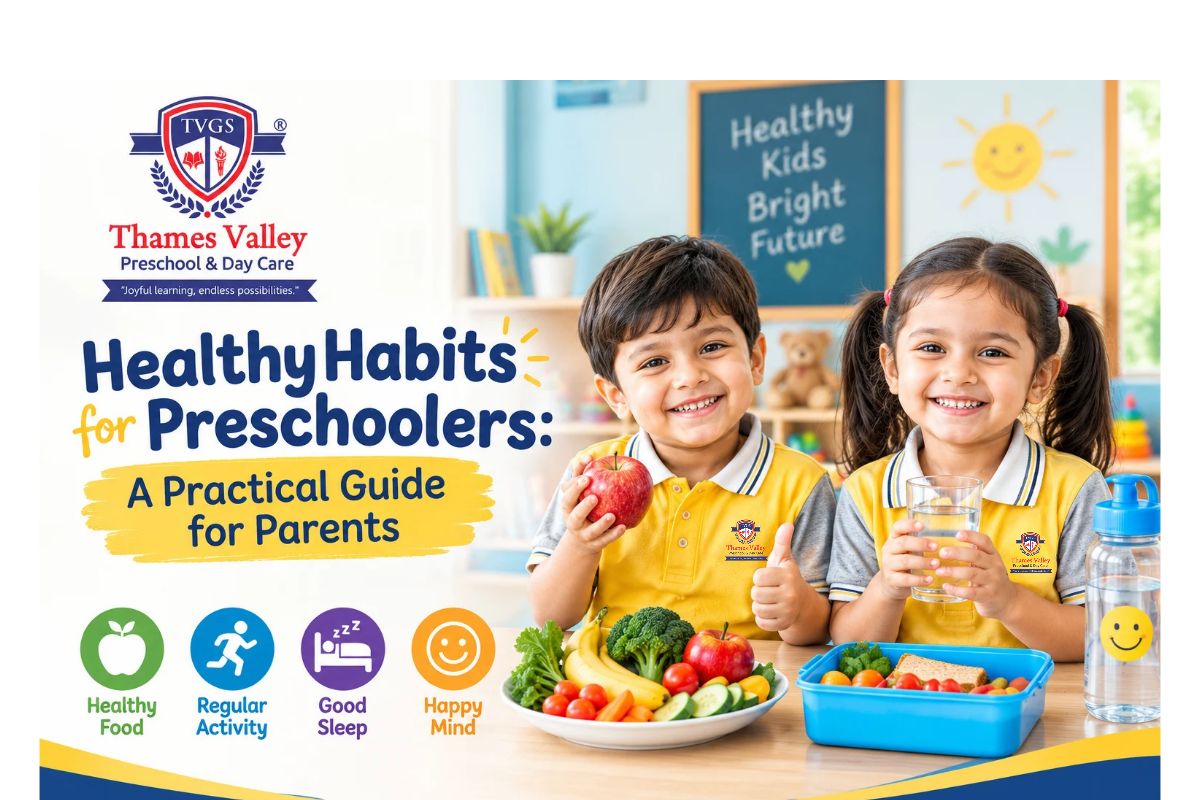
The preschool age is an important age to form habits for young children, as this is the age when routines begin to emerge. Healthy Habits for Preschoolers: A Practical Guide for Parents explains on the habits that parents can ingrain in the child at home and reinforce in preschools. This article is part of Thames Valley Preschool’s parent learning hub on child health and wellness.
Why the Preschool Years Matter for Health
Early childhood is an important phase of life when patterns related to diet, movement, sleep, hygiene and self-care begin to emerge. These routines should not be treated as rules but rather as part of ordinary family life. As preschoolers become more independent, good habits such as washing hands, carrying a water bottle, and putting on shoes should be promoted as routines. For good routines to be a part of daily life, they should be promoted calmly and without forming a rigid structure.
Build Habits Through Routine, Not Pressure
The best way to develop habits is through repetition and modelling. Let your child settle into a predictable sequence such as waking up, washing up, having breakfast, having meals and bedtime, this reduces the amount of decision-making required from the child and normalizes the routine.
Parents should offer limited choices within the routine such as two snack options and two bedtime stories. This gives children more control over their routines.
Food, Movement, Sleep and Hydration Work Together
Parents should consider their child’s whole routine holistically rather can focusing on particular routines. According to WHO’s guidance for children under five, physical activity, sedentary behaviour and sleep are considered to look at the whole pattern instead of one behaviour in isolation.
Healthy Habits at Home and Preschool
It is better if continuity is maintained between the habits learned at school and the habits acquired at home. Parents should ask children whether they followed handwashing habits at the preschool. The preschool can help children reinforce the habits through repeated opportunities and peer modelling.
How Thames Valley Preschool Fits Into the Conversation
Thames Valley preschool provides a child-centered environment, and promotes the physical, social, emotional and intellectual development of the children. Families should find out how a particular routine is implemented at their local center, as implementation can vary by programme and age group.
The Key Takeaway
Healthy Habits for Preschoolers is best promoted as a part of a child’s holistic development instead of a single target. Expectations should be age-appropriate, while opportunities to practice habits should be provided. The child’s response and development should be observed.
If there is any concern, professional advice should be sought instead of relying upon the general online guidance. Thames Valley Preschool ensures the health and wellbeing of students is kept firmly in mind, and that they are developed holistically at our centers.
Frequently Asked Questions
Q1: Why is healthy habits for preschoolers important in the preschool years?
Ans: The preschool years are formative for habits and communication. Repeated experiences during this period can form new habits and reinforce existing habits.
Q2: Should every preschooler develop at exactly the same pace?
Ans: No. Children differ in terms of their learning pace. While milestones are useful reference points, they are not meant to be rigid.
Q3: How can parents and preschool work together?
Ans: Parents should share important routines and observations with teachers in the preschool, and work on a few practical goals instead of requiring identical behaviour in each setting.
Q4: When should parents seek professional advice?
Ans: Parents should seek advice for persistent issues that involve health and safety, or when a child has lost a skill they had acquired earlier.
Q5: How can parents help preschoolers build healthy daily routines?
Ans: Parents can introduce simple routines for meals, hygiene, physical activity, sleep, and other daily activities. Consistency and repeated practice can help children become familiar with these habits.
Q6: What healthy habits should preschoolers learn every day?
Ans: Preschoolers can gradually learn habits such as eating nutritious food, drinking water, staying physically active, getting enough sleep, maintaining personal hygiene, and following simple daily routines.
Q7: How can parents encourage healthy eating habits in preschoolers?
Ans: Parents can offer a variety of nutritious foods and create regular meal and snack routines. Giving children opportunities to try different healthy foods can help them become familiar with balanced eating habits.
Q8: Why is physical activity important for preschoolers?
Ans: Regular physical activity gives preschoolers opportunities to move, play, explore, and develop physical skills. Active play can also become a positive part of their daily routine.
Q9: How can preschoolers learn good hygiene habits?
Ans: Parents and teachers can demonstrate simple hygiene routines such as washing hands, brushing teeth, and keeping personal items clean. Repeating these activities can help children gradually become more independent.
Q10: How can parents make healthy habits easier for young children to follow?
Ans: Parents can keep routines simple, consistent, and appropriate for the child’s age. Demonstrating the habit, giving gentle reminders, and allowing children to practise can make daily routines easier to understand and follow.
References
- WHO — Guidelines on physical activity, sedentary behaviour and sleep for children under 5: https://www.who.int/publications/i/item/9789241550536
- CDC — Developmental Milestones: https://www.cdc.gov/act-early/milestones/
- NAEYC — Developmentally Appropriate Practice: https://www.naeyc.org/resources/position-statements/dap/principles
- NAEYC — The Power of Playful Learning: https://www.naeyc.org/resources/pubs/yc/summer2022/power-playful-learning
- UNICEF — Care for Child Development: https://www.unicef.org/documents/care-child-development
- NHS — Sleep and young children: https://www.nhs.uk/baby/health/sleep-and-young-children/
- NHS — Separation anxiety: https://www.nhs.uk/baby/babys-development/behaviour/separation-anxiety/
- Thames Valley Preschool — Official website: https://thamesvalleyglobal.org/
- Thames Valley Preschool — Admissions: https://thamesvalleyglobal.org/admission/