



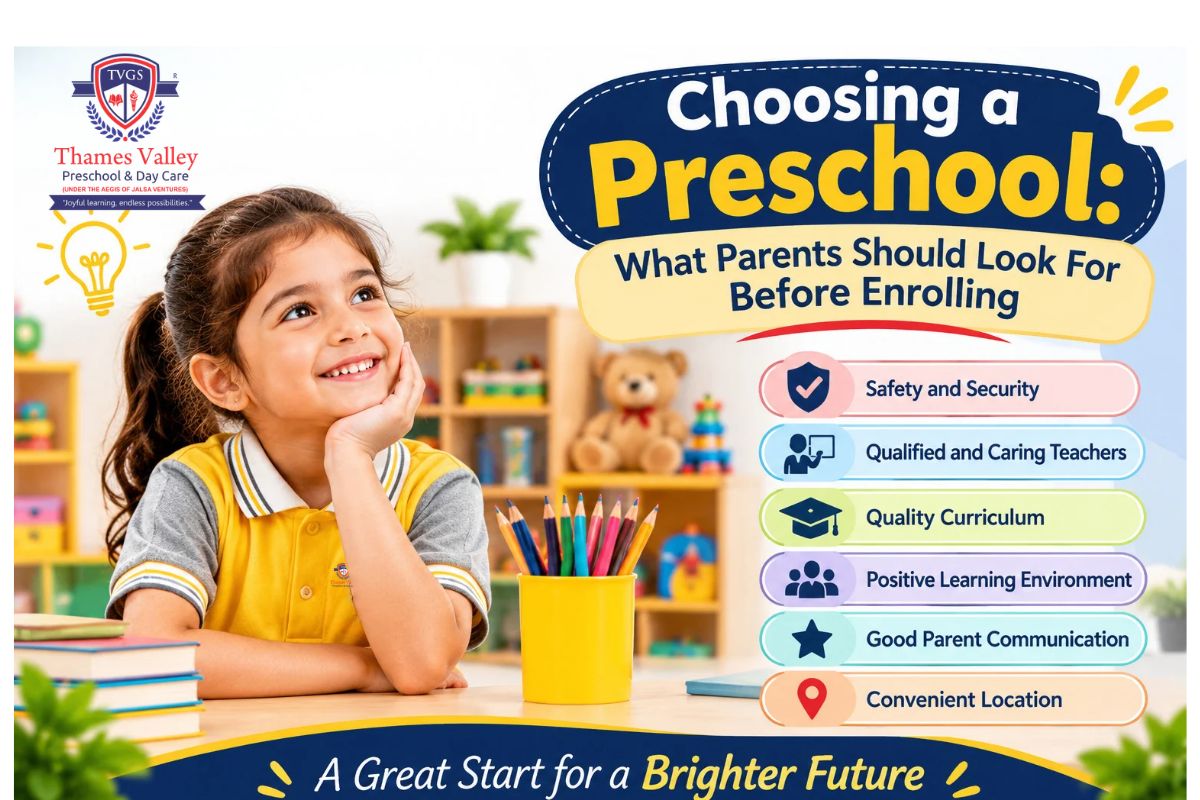
The decision to attend preschool impacts a child’s daily relationships, routines, play and early learning. This guide explains a practical framework for comparing preschools based upon what their child will experience and looks beyond marketing claims.
Observe the Preschool Environment
Parents should visit the preschool when it is open so that they can understand the environment. They should observe how the teachers interact with the students and how they manage group work, playtime, and children’s various activities. Parents should observe how the children behave in the environment and whether they appear engaged or confused. They should observe how the learning material is accessed by the students.
Separate Must-Haves From Nice-to-Haves
Preschools should focus more on safety, developmentally appropriate learning, communication and practical fitness before decorative facilities or a long activity list. Be firm about the non-negotiables before visiting.
Start With Your Child and Family
Make sure that the preschool considers and caters to the child’s practical and developmental requirements: the child’s age and temperament, daily schedule, travel time, language environment, need for daycare, and the environment in which they feel secure and engaged. This lets parents choose preschools based on considerations beyond brand, facilities and list of activities.
Observe What Children Actually Experience
Instead of focusing only on the amenities of the preschool, such as a polished reception area, observe student-teacher engagements, how learning materials are stored and provided to students, the movement and play that are available to students, and how the teachers respond when a student requires help. According to NAEYC’s framework, caring communities, family partnerships, observation, teaching and engaging curriculum are at the centre of quality early learning.
Enquire About Curriculum and Teaching, Not Just Subjects
Parents should not merely enquire whether their preschool teaches phonics, maths or STEM subjects, but ask how concepts are introduced. Preschool learning should be developmentally appropriate and active. Parents should ask teachers how a normal week is carried out, how teachers adapt activities for different students, how much time is spent on free and guided play and how teachers observe and record each child’s progress.
Safety, Health and Communication Are Core Criteria
The entry and collection process should be explained to parents, along with supervision, staff training, hygiene, illness policies, emergency procedures and how the school communicates with families. These details are very important – a child should be physically safe and emotionally secure before learning can be ensured.
Practical Ideas Parents Can Try This Week
Parents should note non-negotiable things that they expect from their preschool. They should especially visit centers when the children are active and ask the same questions at different centers. They should record their observations so that they are not influenced by marketing.
How Thames Valley Preschool Fits Into the Conversation
Thames Valley Preschool includes preschool programmes from Mom and Me through UKG as well as daycare. Its admissions materials describe small-group attention, ongoing progress assessment, parent communication, safety and hygiene practices. Parents considering a centre should still verify current programme details, staffing, timings, policies and facilities with that specific location before admission.
Frequently Asked Questions (FAQs)
Q1: Why is choosing a preschool important in the preschool years?
Ans: Children grow in their habits, communication, movement, independence and social-emotional skills during their preschool years. A preschool experience during this period can create useful foundations for later learning and wellbeing.
Q2: Should every preschooler develop at exactly the same pace?
Ans: No, as children are different in their temperament, experience, and developmental pace. Milestones and age guidance are useful reference points but are not meant to compete among children.
Q3: How can parents and preschool work together?
Ans: Parent should share relevant routines and observations with their preschool, use consistent language and ask how the skill is supported during the school day. Both preschool and parents should aim at developing a small number of practical goals.
Q4: When should parents seek professional advice?
Ans: Parents should seek professional advice when a concern is persistent, severe, involves health or safety, interferes with daily life or when a child has lost a skill they previously had.
Q5: What should parents look for during a preschool visit?
Ans: Parents should observe teacher-child interactions, classroom cleanliness, safety arrangements, play areas, learning materials and how teachers respond to children’s needs. Visiting during regular school hours can provide a better understanding of the daily environment.
Q6: How important is the teacher-child ratio when choosing a preschool?
Ans: The teacher-child ratio is important because it affects the attention and supervision children receive. Parents should ask how many children are assigned to each teacher and whether additional staff are available during activities, meals and playtime.
Q7: Is play-based learning important in preschool education?
Ans: Yes, play-based learning helps children explore ideas, communicate, solve simple problems and interact with others. Parents should check whether the preschool provides a balance of guided activities and free play.
Q8: How can parents know if a preschool is suitable for their child’s personality?
Ans: Parents should consider their child’s age, temperament, interests and comfort level. They can ask about classroom routines, group activities, teacher support and how the school helps children adjust to a new environment.
Q9: What questions should parents ask preschool teachers before admission?
Ans: Parents can ask about the daily routine, teaching methods, classroom size, safety procedures, progress updates, parent communication, and how teachers support children who need extra attention.
Q10: How can parents help children adjust to a new preschool?
Ans: Parents can prepare children by talking positively about school, explaining the daily routine, visiting the preschool together and maintaining a consistent drop-off routine. Staying in regular communication with teachers can also help parents understand their child’s adjustment.
References
WHO — Guidelines on physical activity, sedentary behaviour and sleep for children under 5: https://www.who.int/publications/i/item/9789241550536
CDC — Developmental Milestones: https://www.cdc.gov/act-early/milestones/
NAEYC — Developmentally Appropriate Practice: https://www.naeyc.org/resources/position-statements/dap/principles
NAEYC — The Power of Playful Learning: https://www.naeyc.org/resources/pubs/yc/summer2022/power-playful-learning
UNICEF — Care for Child Development: https://www.unicef.org/documents/care-child-development
NHS — Sleep and young children: https://www.nhs.uk/baby/health/sleep-and-young-children/
NHS — Separation anxiety: https://www.nhs.uk/baby/babys-development/behaviour/separation-anxiety/