



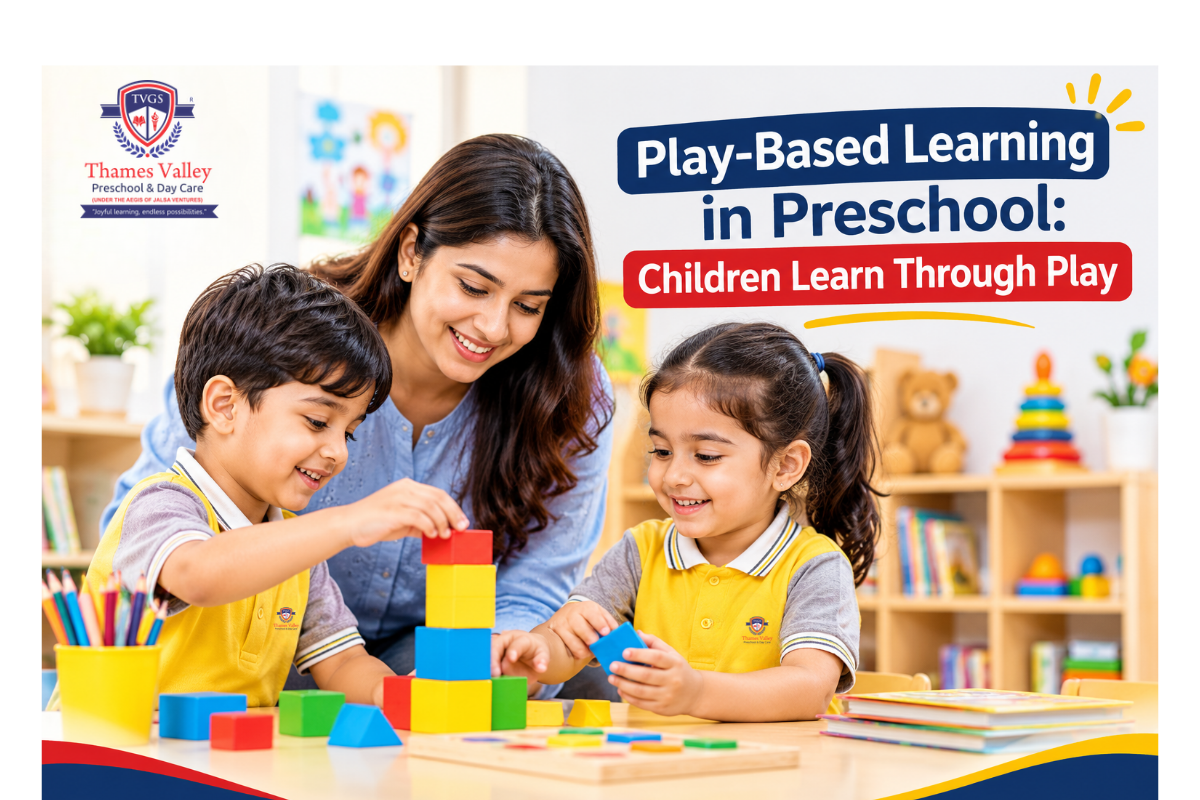
Play-Based Learning converts young children into active participants of play rather than passive recipients of knowledge. Play-Based Learning in Preschool: How Children Learn Through Play explains what parents should seek in a preschool experience, how play and teaching are intertwined and how teachers carry out lessons in a play-based way.
Free Play and Guided Play Both Matter
Children feel more in control of their ideas and roles when they engage in self-led free play. Guided play, in which adults influence the play environment or pose a problem also has its benefits. It is important that the parents take on an observational role instead of dominating the activity, in order to best support learning.
It is important that the parents ask whether the child is receiving repeated, low-pressure opportunities to practice.
What Children Learn Through Play
Children learn several skills during play. Building a block structure teaches students about measurement, balance, planning and collaboration, while pretend play involves narration, builds vocabulary, helps the child self-regulate and improves his or her perspective. Outdoor games also allow the child to move and develops his or her social negotiation skills. Play-based learning makes the curriculum come to life, as children enact many theoretical learnings in play.
Preschool Is More Than Early Academics
A preschool experience provides a child with many opportunities to develop his or her skills. Along with teaching literacy and numeracy, preschools provide students with an opportunity for language-rich interaction, movement, play, stories, creative work, exploration, routines and relationships. According to NAEYC, developmentally important activities can be strengths-based and play based, as they support development across physical, cognitive, social and emotional domains. See Benefits of Preschool: How Early Education Supports a Child’s Development for more information about the benefits of a preschool education.
Why Play and Learning Belong Together
Preschoolers utilize their intellectual skills the most in play. Building a simple block figure requires cause-and-effect, while pretend play builds language, counting and social negotiation. NAEYC holds play and learning to be different sides of the same coin – a good curriculum is often play-based.
Readiness Is Broader Than Reading and Writing
Going to preschool benefits children as it enables them to communicate their needs, tolerate separations from their families, follow routines, participate in play and attempt age-appropriate self-care. These skills are honed in preschool, which prepares students for formal schools.
What a Balanced Curriculum Looks Like
A balanced preschool curriculum provides children the opportunities to practice communication and language skills and learn early literacy and mathematics. It also develops them physically, allows them to creatively express themselves and builds the foundation for social-emotional learning. Each child’s individuality and context should be kept in mind while developing their skills. Parents should enquire how students actually learn at a preschool. See Child Development in the Preschool Years: Milestones, Skills and How Children Learn for more details.
Practical Ideas Parents Can Try This Week
These are many ways through which parents can contribute to their child’s learning at home. They can read together with their child, engage in pretend play, let the child solve small real-life problems, talk about their observations, and enquire from the preschool how their activities relate to learning goals.
How Thames Valley Preschool Fits Into the Conversation
Thames Valley Preschool provides an opportunity for students to learn through a Montessori, STEM, experiential learning and tech-enabled education. Our programs also develop the students’ language, numeracy, motor development, practical life activities and hands-on learning.
The Key Takeaway
Play-based learning in Preschool should aim at achieving the child’s wider developmental goals rather than a single target to optimize. At our center, Expectations should be age-appropriate, and children should be provided many repeated opportunities to practice. In case of any concerns, seek professional advice instead on relying on general online guidance.
Frequently Asked Questions (FAQs)
Q1: Why is play-based learning in preschool important in the preschool years?
Ans: Preschool years witness a rapid growth in habits, communication, movement, independence and social-emotional skills of children. If students repeat activities during this age, they form meaningful foundation for their life.
Q2: Should every preschooler develop at exactly the same pace?
Ans: No, as children are different in their temperament, experience and developmental pace. Milestones and guidance should not be used to compare between students.
Q3: How can parents and preschool work together?
Ans: Parents should share their child’s routines and observations with the preschool, and enquire how important skills are developed by the preschool.
Q4: When should parents seek professional advice?
Ans: In case of any persistent or issue, seek professional help.
Q5: What is play-based learning in preschool?
Ans: It is learning through hands-on activities like storytelling, blocks, role play and art. It builds thinking, language and social skills naturally.
Q6: How can I choose the right preschool for my child?
Ans: Look for a safe campus, caring teachers, an age-appropriate curriculum and a good teacher-child ratio. Visit the school and observe the classrooms before deciding.
Q7: What is the right age to start preschool?
Ans: Most children are ready between 2.5 and 3 years. Readiness depends on comfort with separation and routines, not just age.
Q8: How can parents help their child settle in during the first few weeks?
Ans: Keep a steady routine, talk positively about school and keep goodbyes short. Share your child’s habits with the teacher for a smooth transition.
Q9: How does preschool help children become independent?
Ans: Daily routines like washing hands, eating alone and tidying up build self-help skills. These small tasks grow confidence and decision-making.
Q10: How do screen time and outdoor play affect a child’s development?
Ans: Outdoor play builds motor skills and social bonds, while too much screen time limits movement and communication. Balance both, with a focus on active play.
References
WHO — Guidelines on physical activity, sedentary behaviour and sleep for children under 5: https://www.who.int/publications/i/item/9789241550536
CDC — Developmental Milestones: https://www.cdc.gov/act-early/milestones/
NAEYC — Developmentally Appropriate Practice: https://www.naeyc.org/resources/position-statements/dap/principles
NAEYC — The Power of Playful Learning: https://www.naeyc.org/resources/pubs/yc/summer2022/power-playful-learning
UNICEF — Care for Child Development: https://www.unicef.org/documents/care-child-development
NHS — Sleep and young children: https://www.nhs.uk/baby/health/sleep-and-young-children/
NHS — Separation anxiety: https://www.nhs.uk/baby/babys-development/behaviour/separation-anxiety/