




During the preschool years, children are learning how to regulate themselves and are developing their independence faster than their ability to manage their emotions and impulses. Screen Time for Preschoolers: Healthy Limits, Habits and Better Alternatives seeks to practically guide parents on how to create structure, support connections and build skills without expecting too much self-control from a young child.
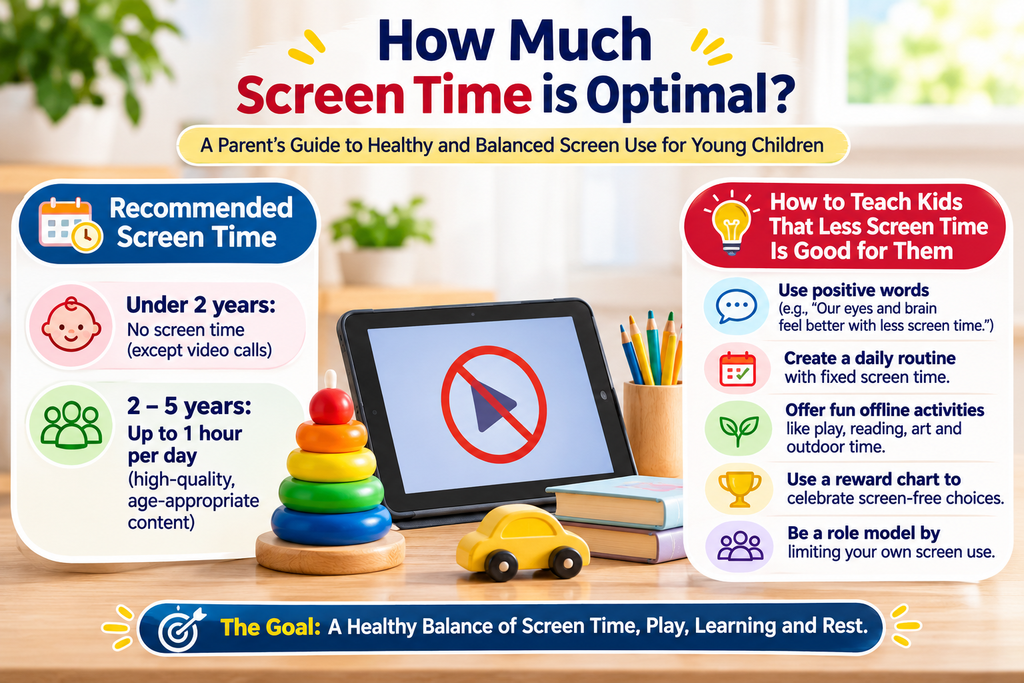
How Much Screen Time is Optimal?
According to the WHO, children between the ages of three and four should not be allowed more than one hour of sedentary screen time in a day. This is to protect time for sleep, movement, conversation, play and hands-on exploration. For parents, it is important to know if the environment provides them with repeated, low-pressure opportunities to practice. Small adjustments should be made every day instead of hoping for a routine that lasts for a week.
Quality Matters
Parents should let their child view age-appropriate content and avoid autoplay where possible. They should watch or play together so that the screen becomes a prompt for conversation. Mealtime and the period before bedtime should be free of screens. Devices should not be used to manage boredom or distress.
Preschoolers Need Both Structure and Growing Independence
Children between the ages of two and five are still dependent upon adults for regulations and security, as they manage to do more for themselves. Parenting then becomes a balance: clear boundaries make the day predictable, while small choices and responsibilities develop independence. The goal is to let the child practice skills in a safe relationship.
You May Also Like: Preschool Readiness: Signs, Skills and How to Prepare Your Child
Connection Makes Guidance Easier
Children cooperate with adults readily when they understand what is happening for them. Naming an emotion, getting down to the child’s level and using short instructions is more effective than explanations during a difficult moment. When the child is calm, he/she can then ask for a turn, say goodbye, put a device away and follow a bedtime routine.
These everyday experiences can also be supported through a well-structured curriculum that encourages emotional understanding, communication and positive behavior
Routines Reduce Friction
Predictable routine such as a fixed time for waking up, meals, preschool, active play, quiet time and bedtime let the child predict the next routine. It is important to make the routine more consistent – weekends and special days can differ while the usual days follow a similar sequence.
Technology Should Complement Childhood, Not Replace It
Screentime can be useful for communication and learning experiences, but they take away the time for conversation, physical play, sleep and hands-on exploration. According to WHO, children between the ages of three and four should not receive more than an hour of screentime. Quality, context and co-use matter along with the duration: watching along with parents is different from letting a child be with be gadget alone, watching an endless feed.
You May Also Like: Daily Routine for Preschoolers
Some Practical Ideas for Parents to Try
Parents can use one visual routine, offer two acceptable choices, create one screen-free family period, name emotions during calm moments, and let the child practice an independence task such as tucking away toys or carrying a bag.
How Thames Valley Preschool Fits Into the Conversation
Thames Valley Preschool provides a child-centric environment that pays attention to the child’s physical, social, emotional and intellectual development, along with age-specific preschool programmes. Parents should discuss how a routine or developmental skill is supported at their local centre, as day-to-day implementation differs by programme and age group.
The Key Takeaway
Screen time for preschoolers is not a single target to optimize but a part of the child’s wider development. Expectations should be age-appropriate, with repeated opportunities to practice. The child’s response should be observed and parents should work with educators at our centre, Thames Valley Preschool. In case of persistent concerns, parents should seek medical advice instead of relying on online guidance..
Frequently Asked Questions (FAQs)
Q1: Why is screen time for preschoolers important in the preschool years?
Ans: During the preschool years, children grow rapidly in habits, communication, movement, independence and social-emotional skills. Repeating habits during this period can create useful foundations for learning and wellbeing in the future.
Q2: Should every preschooler develop at exactly the same pace?
Ans: No, as children are different in their temperament, experience and developmental pace. Milestones should be useful reference points and not a competition. In case of persistent concerns, or loss of previously acquired skills, parents should discuss with a professional.
Q3: How can parents and preschool work together?
Ans: Parents should discuss routines and observances, use consistent language where helpful, and ask how the skill is supported during the day. Parents should focus on small practical goals than expecting identical behaviour in every setting.
Q4: When should parents seek professional advice?
Ans: Parents should seek individual advice when a concern is persistent, severe, involves health or safety risk, and interferes with daily life.
Q5. Is screen time before bedtime suitable for preschoolers?
Ans: Parents should avoid screens before bedtime and establish a predictable bedtime routine to support healthy habits.
Q6. How can parents help children stop using screens without tantrums?
Ans: Parents can give a clear warning before screen time ends, use short instructions and offer another activity. Staying calm and maintaining consistent boundaries can make the transition easier.
Q7. What are some healthy alternatives to screen time for preschoolers?
Ans: Parents can encourage outdoor play, drawing, storytelling, puzzles, building blocks, music and simple household activities.
Q8. Should parents watch digital content with their preschoolers?
Ans: Yes. Watching together allows parents to discuss what children see, ask questions and turn screen time into an opportunity for conversation and learning.
Q9. How can daily routines help manage screen time?
Ans: A predictable routine for meals, preschool, active play, quiet time and bedtime helps children understand what comes next and makes screen-time boundaries easier to follow.
Q10. When should parents seek professional advice about their child’s screen habits?
Ans: Parents should seek professional advice if screen-related concerns persist, affect daily activities or involve health and safety risks.
References
WHO: Guidelines on physical activity, sedentary behaviour and sleep for children under 5: https://www.who.int/publications/i/item/9789241550536
CDC: Developmental Milestones: https://www.cdc.gov/act-early/milestones/
NAEYC: Developmentally Appropriate Practice: https://www.naeyc.org/resources/position-statements/dap/principles
NAEYC: The Power of Playful Learning: https://www.naeyc.org/resources/pubs/yc/summer2022/power-playful-learning
UNICEF: Care for Child Development: https://www.unicef.org/documents/care-child-development
NHS: Sleep and young children: https://www.nhs.uk/baby/health/sleep-and-young-children/
NHS: Separation anxiety: https://www.nhs.uk/baby/babys-development/behaviour/separation-anxiety/