



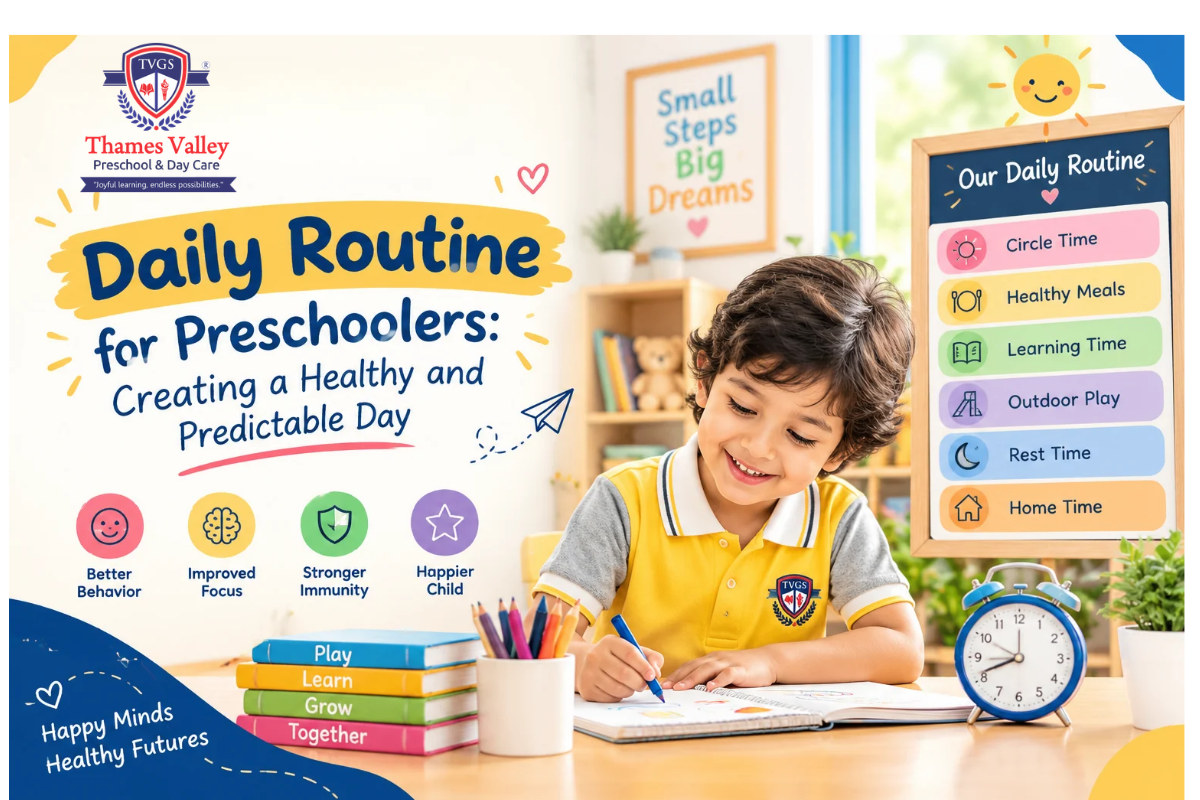
Creating a Daily Routine for Preschoolers may seem difficult as preschoolers are developing quickly and still learning to regulate their actions and emotions. This guide explains how preschoolers can be influenced to follow a daily routine with structure and how they can build skills without having the perfect self-control like adults.
Preschoolers Need Both Structure and Growing Independence
Children between the ages of two and five are still in the phase of development where they are learning to do more for themselves while being dependent upon adults for safety and security. Parents need to set clear boundaries and make the day more predictable. The motive is to make the child practice skills in a safe relationship.
Connection Makes Guidance Easier
Children should feel connected with the adults and adults should understand the child’s level of comfort. It can be more sensible to name an emotion, get down to the child’s level and use short, concrete instructions than lengthy explanations during a difficult period.
Routines Reduce Friction
Predictable routines with defined wake-up time, mealtime, preschool, active play, quiet time and bedtime can help children understand what comes next. A healthy routine makes the day more structured and easier to follow. Visual routines are useful as they turn verbal reminders into something a child can follow more independently.
Technology Should Fit Around Childhood, Not Replace It
Screetime should not be excessive, and technology should be used for learning experiences. Too much of screentime reduces the time for conversation, physical play, sleep and exploration. According to WHO, children between the ages of three and four should be allowed no more than one hour of screen time. Quality, context and co-use matters along with duration.
Practical Ideas Parents Can Try This Week
Parents should practice creating one visual routine and create one screen -free family period. They should name emotions during calm moments and let the child practice one independent task such as packing away toys or carrying a bag. The experiment should be simple enough to be repeatable. If it suits, maintain it before adding another change.
How Thames Valley Preschool Fits Into the Conversation
Thames Valley Preschool publicly provides a child-centered environment with attention to physical, social, emotional and intellectual development, along with age-specific preschool programmes. Families should discuss how the relevant routine or developmental area is supported at their local centre, because day-to-day implementation can vary by programme and age group.
The Key Takeaway
Creating a healthy and predictable day matters for preschoolers, as it makes their routines consistent and structured. At Our Center, as children are rapidly growing during the preschool years, it becomes important to introduce elements of structure that can aid in forming habits later on for the child.
Frequently Asked Questions (FAQs)
Q1: Why is daily routine for preschoolers important in the preschool years?
Ans: The preschool years involve growth in habits, communication, movement, independence and social-emotional skills. Repeated everyday experiences during this period can form useful foundations for later learning and wellbeing.
Q2: How can parents and preschool work together?
Ans: Share relevant routines and observations, use consistent language where helpful, ask how the skill is supported during the school day, and focus on a small number of practical goals rather than expecting identical behaviour in every setting.
Q3: When should parents seek professional advice?
Ans: Seek individual advice when a concern is persistent, severe, involves health or safety, interferes substantially with daily life, or when a child has lost a skill they previously had.
Q4. Why is a daily routine important for preschoolers?
Ans: A daily routine helps preschoolers feel secure, develop independence, and understand what to expect throughout the day.
Q5. How can parents create a healthy daily routine for preschoolers?
Ans: Parents can establish consistent times for waking up, meals, play, learning activities, and bedtime while allowing flexibility for the child’s needs.
Q6. What should a preschooler’s daily schedule include?
Ans: A balanced schedule should include adequate sleep, nutritious meals, physical activity, preschool learning, quiet time, and family interaction.
Q7. How do visual routine charts help preschoolers?
Ans: Visual routine charts use pictures or simple steps to help children understand daily tasks, follow instructions, and become more independent.
Q8. How much screen time is appropriate for preschoolers?
Ans: According to WHO, children aged 3–4 should have no more than one hour of sedentary screen time per day; less is better. Parents should prioritise active play, sleep, and interaction.
Q9. How can parents manage tantrums during daily routines?
Ans: Parents can stay calm, acknowledge their child’s emotions, provide simple instructions, and use predictable routines to make transitions easier.
Q10. How can parents and preschool teachers work together to build consistent routines?
Ans: Parents and teachers can share observations, communicate regularly, and encourage similar habits, such as tidying toys and practising age-appropriate independence, at home and preschool.
Sources / Editorial References
WHO — Guidelines on physical activity, sedentary behaviour and sleep for children under 5: https://www.who.int/publications/i/item/9789241550536
CDC — Developmental Milestones: https://www.cdc.gov/act-early/milestones/
NAEYC — Developmentally Appropriate Practice: https://www.naeyc.org/resources/position-statements/dap/principles
NAEYC — The Power of Playful Learning: https://www.naeyc.org/resources/pubs/yc/summer2022/power-playful-learning
UNICEF — Care for Child Development: https://www.unicef.org/documents/care-child-development
NHS — Sleep and young children: https://www.nhs.uk/baby/health/sleep-and-young-children/
NHS — Separation anxiety: https://www.nhs.uk/baby/babys-development/behaviour/separation-anxiety/
Parenting Preschoolers: A Practical Guide for Independance
October 31, 2026[…] to wake up, for meals, preschool, active play, quiet time and bedtime as it organizes their day. Routines can also be followed by children more easily. Consistency makes the day more identical and lets […]