


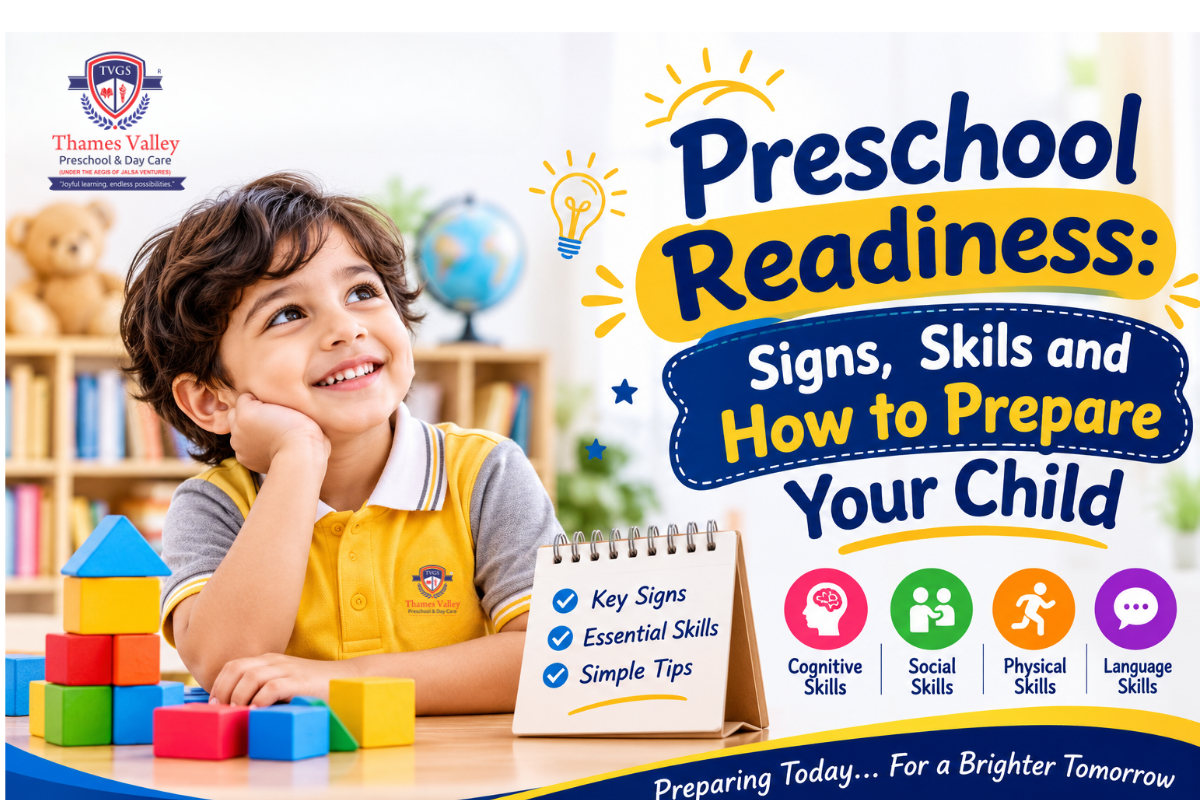
Preschool offers many opportunities for your child to develop academically, socially and emotionally. However, children should be prepared to make the most out of their preschool years by parents. Preschool Readiness: Signs, Skills and How to Prepare Your Child explains how preschool learning should appear and how parents can prepare their child to make the best out of preschool.
What Preschool Readiness Really Means
Preschool readiness does not mean academic readiness or ability, but rather the development of social, emotional, physical, language, and thinking skills which are required for the child to grow in a preschool environment. Children should be able to ask for help, join group activity and manage their routines as they join a preschool.
Practise Through Everyday Life
Children should be able to carry their own bags, open simple containers, wash their hands, manage their toys, listen to short stories and spend time with adults. These day-to-day abilities build their confidence and independence, and encourage them to learn better at their preschool.
Preschool Is More Than Early Academics
A lot of parents mistake preschool to be an earlier version of primary school. While preschool delivers several learning lessons, it should be viewed as a developmental stage in itself, as young children require many interactions, movement, play, stories, creative work, exploration, routines and relationships along with literacy and numeracy.
Why Play and Learning Belong Together
Play encourages preschoolers to use their complex thinking skills and develop critical thinking, problem solving, counting and social negotiation. According to NAEYC, play and learning are not opposites but complementary. Learning can include play-based methods to improve delivery.
Readiness Is Broader Than Reading and Writing
A young child should be able to communicate basic needs, tolerate short separations, follow simple routines, participate in play and be able to look after himself/herself. These skills are gradually developed after admission, with the support of parents and teachers. Preschool should be understood to be a transition period for a child where he/she gradually develops into an individual.
What a Balanced Curriculum Looks Like
A balanced preschool curriculum should provide children with many opportunities to communicate and improve their language. It also provides them skills in early literacy, mathematics, physical development, creative expression and social-emotional learning. NAEYC provides meaningful developmental goals for children while recognizing their individuality. Parents should not merely focus on children academic learning at preschool.
Practical Ideas Parents Can Try This Week
Parents can read with their child, engage in pretend play, let them construct objects, invite the child to solve real-life problems, talk about what they notice outdoors and enquire from the preschool how classroom activities forward learning goals.
How Thames Valley Preschool Fits Into the Conversation
Thames Valley Preschool’s pedagogy is a mix of Montessori, STEM, experiential learning and tech-led education. It provides an education in language, numeracy, motor development, practical life activities and hands-on learning. It allows children to develop at their own pace in a friendly, play based manner and encourages children to develop into their best selves.
The Key Takeaway
Preschool readiness is a gradual process which is not necessarily present in children when they begin preschool. Parents should have age-appropriate expectations, and try to create repeated opportunities to practice new activities to develop skills. Our center can be part of this process by providing opportunities for children to practice age-appropriate activities. In case of persistent concerns, parents should seek advice from a qualified pediatrician.
Frequently Asked Questions (FAQ’s)
Q1: Why is preschool readiness important in the preschool years?
Ans: The preschool years are unique as they lead to rapid development in habits, communication, movement, independence and social-emotional skills. Repeated everyday experiences form useful habits for later wellbeing and learning.
Q2: Should every preschooler develop at exactly the same pace?
Ans: No, as children vary in their temperament and developmental pace. Milestones and age guidance are not meant to compete between students. In case of loss of acquired skills, parents should discuss the concern with an appropriate professional.
Q3: How can parents and preschool work together?
Ans: Parents should share relevant routines and observations with preschool teachers, and use consistent language where possible, enquire whether a skill is supported during the school day and focus on small number of goals rather than expecting identical behaviour across all settings.
Q4: When should parents seek professional advice?
Ans: Parents should seek individual advice when a concern is persistent, severe, interferes with daily life or when the child has lost a skill he previously had.
Q5. Should every child develop preschool readiness at the same age?
Ans: No. Children develop at different rates, so readiness should be considered individually rather than used to compare children.
Q6. How can parents build independence before preschool?
Ans: Encourage children to put away toys, wash their hands, open simple containers, and practise everyday routines.
Q7. What should a balanced preschool curriculum include?
Ans: It should support language, early literacy, numeracy, physical development, creativity, play, and social-emotional learning.
Q8. How can parents and preschool teachers support readiness together?
Ans: Parents and teachers can share observations, maintain consistent routines, and work on a few age-appropriate goals together.
Q9. When should parents seek professional advice about preschool readiness?
Ans: Seek advice from a qualified pediatrician if concerns persist, affect daily life, or a child loses a previously acquired skill.
Sources / Editorial References
WHO — Guidelines on physical activity, sedentary behaviour and sleep for children under 5: https://www.who.int/publications/i/item/9789241550536
CDC — Developmental Milestones: https://www.cdc.gov/act-early/milestones/
NAEYC — Developmentally Appropriate Practice: https://www.naeyc.org/resources/position-statements/dap/principles
NAEYC — The Power of Playful Learning: https://www.naeyc.org/resources/pubs/yc/summer2022/power-playful-learning
UNICEF — Care for Child Development: https://www.unicef.org/documents/care-child-development
NHS — Sleep and young children: https://www.nhs.uk/baby/health/sleep-and-young-children/
NHS — Separation anxiety: https://www.nhs.uk/baby/babys-development/behaviour/separation-anxiety/