



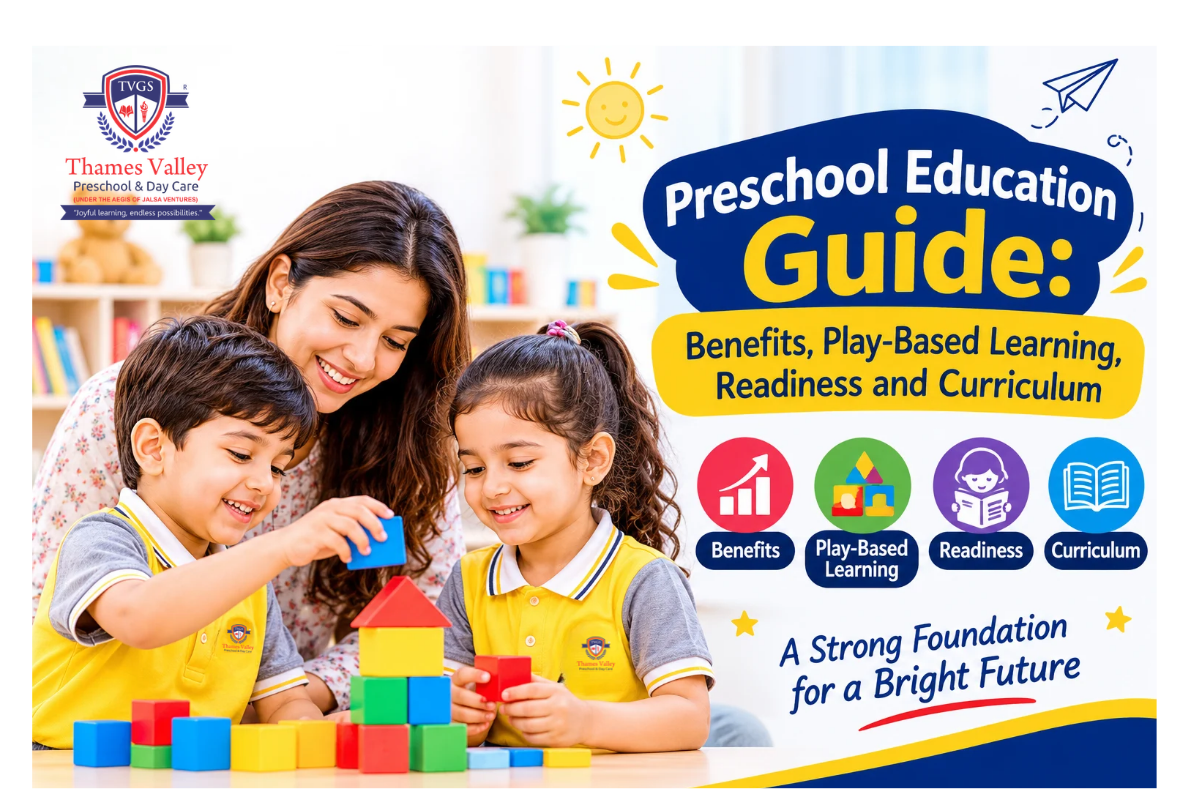
Preschool education becomes most beneficial when young children are made active participants in the process of attaining knowledge. Preschool Education Guide: Benefits, Play-Based Learning, Readiness and Curriculum explains what the advantages of preschool following a play-based learning methodology and what parents should note in a preschool learning experience.
More Than Early Academics
Preschool does not merely serve to provide a foundation for school. Young children require rich interactions, and plenty of opportunities to play, engage in stories, explore an develop their basic literacy and numeracy. Benefits of a preschool are realized as children develop patterns over days and weeks. Parents should share their child’s routines and observations with the preschool and ensure that the child makes progress in a supportive environment.
Play and Learning Belong Together
For very young children, play is a form of learning. Children often learn more through play than they learn through lessons. Play teaches them many lessons in planning and cause-and -effect, language, counting and social negotiation. According to NAEYC, play and learning are not opposites but often reinforce each other as many educational lessons can be delivered through play-based methodologies.
Readiness Is Broader Than Reading and Writing
Children preparing to attend preschool should be able to communicate their basic needs, tolerate short separations from their parents, follow simple routines, participate in play and be able to care for themselves. These skills need not be present before admission but are refined by attending the preschool. Preschool readiness therefore is gradually developed and should not be treated as an entrance examination.
What a Balanced Curriculum Looks Like
A balanced preschool curriculum should provide children with many repeated opportunities to communicate and practice their language skills. They should also be able to progress in early mathematics and physical development, as well as creative expression, social-emotional learning and understanding the world around them. NAEYC recognizes each child’s individuality and context as they achieve goals across domains, and encourages parents to identify signs of learning beyond a list of subjects.
Learning Journey at the Thames Valley Preschool
Thames Valley Preschool follows a pedagogy that combines Montessori, STEM, experiential learning and technology enabled learning, with programmes ranging from Mom and Me and Play Group through Nursery, LKG and UKG. It seeks to pay attention to children in small groups, with emphasis on their motor development, language, numeracy, play and innovation activities.
Practical Ideas Parents Can Try This Week
Parents should read together with their child, and allow them to engage in pretend and construction play. The child should be invited to solve small real-life problems, talk about their observations and ask the preschool for examples of how current classroom activities connect to learning goals.
The Key Takeaway
Parents can realize the benefits of preschools when they share their children’s routines and observations with our center and understand that preschool education is a part of their child’s wider development rather than a single educational target. Expectations should be age appropriate and the child’s responses should be observed. In case of concerns, individual professional advice should be sought rather than relying on general online guidance.
Frequently Asked Questions (FAQ’s)
Q1: Why is preschool education important in the preschool years?
Ans: The preschool years develop children’s habits, communication, movement, independence and social-emotional skills. Repeated everyday experiences during this period can develop foundations for later learning.
Q2: Should every preschooler develop at exactly the same pace?
Ans: No, as children differ in temperament, experience and development pace. Developmental milestones should not serve as a competition. Any concerns should be discussed with a appropriate professional.
Q3: How can parents and preschool work together?
Ans: Parents should share relevant routines and observations with the preschool, ask how a skill is supported during a school day and focus on practical goals rather than on expecting identical behaviour in every setting.
Q4: When should parents seek professional advice?
Ans: Seek individual advice when a concern is persistent, severe, involves health or safety, interferes substantially with daily life, or when a child has lost a skill they previously had.
Q5: How can I tell if my child is ready for preschool?
Ans: Readiness is about comfort more than age. Children are often ready when they can stay with another caring adult for a short time, show interest in other children, follow simple instructions, and express basic needs in words or gestures.
Q6: How can I support my child’s learning at home?
Ans: Everyday routines do most of the work. Talk with your child, read together, let them help with small tasks, and make time for play. Ask what they enjoyed at school instead of testing what they learned.
Q7: What should I ask the teacher about my child’s progress?
Ans: Ask how your child settles, plays with others, and takes part in activities. Also ask which skills the teacher is focusing on and how you can support them at home. Specific examples are more useful than general comments.
Q8: Is it normal for a child to cry when starting preschool?
Ans: Yes, many children cry in the first few weeks. A steady routine, short and calm goodbyes, and open communication with the teacher usually help. If distress continues for a long time, talk to the school about a gradual approach.
Q9: How do I know if a preschool respects each child’s pace?
Ans: Watch how teachers respond to individual children. A supportive classroom offers different ways to take part and does not expect every child to do the same thing at the same time. Ask how teachers support a child who needs more time.
Q10: How much homework or formal learning is right in the preschool years?
Ans: Very little. Young children learn best through play, stories, songs, and hands-on activities. Short, light activities at most are enough, and early writing practice should not replace play.
References
WHO — Guidelines on physical activity, sedentary behaviour and sleep for children under 5: https://www.who.int/publications/i/item/9789241550536
CDC — Developmental Milestones: https://www.cdc.gov/act-early/milestones/
NAEYC — Developmentally Appropriate Practice: https://www.naeyc.org/resources/position-statements/dap/principles
NAEYC — The Power of Playful Learning: https://www.naeyc.org/resources/pubs/yc/summer2022/power-playful-learning
UNICEF — Care for Child Development: https://www.unicef.org/documents/care-child-development
NHS — Sleep and young children: https://www.nhs.uk/baby/health/sleep-and-young-children/
NHS — Separation anxiety: https://www.nhs.uk/baby/babys-development/behaviour/separation-anxiety/