


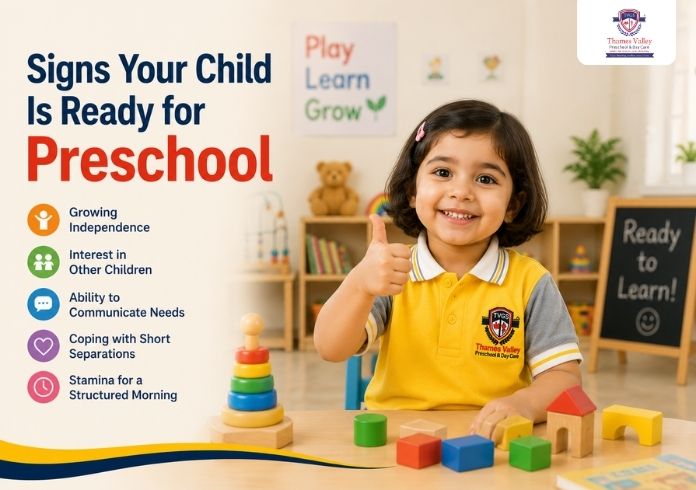
“Is my child ready?” is one of the most common — and most anxious — questions parents ask. The reassuring truth is that readiness for preschool is about more than a birthday. Some children are ready earlier than their age suggests, and some benefit from a few extra months. Rather than fixating on a date, watch for these everyday signs, which together paint a far clearer picture than age alone.
1. Growing independence
Can your child manage small tasks with a little help — washing hands, eating, putting on shoes, using the toilet? None of these needs to be perfect. What you’re looking for is a willingness to try things themselves and a bit of pride in doing so. That budding independence is the foundation for a happy preschool day.
2. Interest in other children
Does your child watch other children with curiosity, or light up around them at the park? Young children don’t need to be expert sharers — that’s exactly what preschool teaches — but a natural pull towards other children suggests they’re ready for the social world of a classroom.
3. The ability to communicate needs
Your child doesn’t need a big vocabulary, but they should be able to make basic needs understood — through words, gestures or pointing — such as being hungry, tired or needing the washroom. Being able to signal “I need help” is what keeps a child feeling safe when a parent isn’t in the room.
4. Coping with short separations
Can your child spend a short stretch of time with a grandparent or familiar caregiver without becoming inconsolable? Some tears are completely normal, but a child who can be comforted and settle down is showing they can handle the separation that preschool involves.
5. Stamina for a structured morning
Preschool has a rhythm — circle time, activities, snack, play. A child who can stay engaged with an activity for a little while and follow simple instructions is likely to enjoy that structure rather than find it overwhelming.
| TIP Remember: readiness is a range, not a finish line. No child ticks every box perfectly — a good preschool meets children where they are and grows these skills alongside them. |
What if the signs are mixed?
Mixed signals are completely normal, and they’re not a reason to worry. If your child is confident socially but still working on independence, a nurturing play group can build the rest gently. The environment matters as much as the checklist: a warm, well-run classroom draws readiness out of children rather than demanding it upfront. Our guide on how to prepare your child for preschool admission has simple ways to build these skills in the weeks before starting.
Balancing readiness with age
Age still matters for admission because schools have cut-off dates, but readiness tells you whether the timing is right for your particular child. For how age criteria work across stages and states, see our complete preschool admission guide for parents in India.
Frequently asked questions
Q1 : At what age is a child usually ready for preschool?
Ans : Many children are ready for play group around 2–3 years and nursery around 3–4 years, but readiness varies. Watch for independence, social interest and communication rather than relying on age alone.
Q2 : Is it okay to wait an extra year?
Ans :, if your child needs it. There is no harm in giving a child a little more time to develop independence and social comfort, especially for borderline birthdays.
Q3 : My child cries when I leave — are they not ready?
Ans :Not necessarily. Separation tears are normal and usually pass quickly once settled. If your child can be comforted and re-engages in play, that’s a good sign of readiness.
Q4 : How can I tell if my child is emotionally ready for preschool?
Ans :A child who can cope with short separations, express basic emotions, and gradually adjust to new environments is often emotionally ready for preschool.
Q5 : Does my child need to be toilet trained before starting preschool?
Ans :Policies vary by school. Many preschools encourage toilet training, while others provide support during the transition. It’s best to check the preschool’s admission guidelines.
| Visit Thames Valley PreschoolGive your child a joyful, safe and inspiring start. Book a campus visit to meet our teachers, see our safety systems, and find the right programme — from Mom & Me to UKG, plus post-school day care.
Enquire about admissions → https://thamesvalleyglobal.org/ |